This week’s topic was about narratives and if storytelling and interactivity go hand-in-hand. Although my group discussed a show called Adventure Time, which works in an episodic format that is in line with Vladimir Propp’s 8 characters types, time to time has experimental narratives, works as a bit of all the types (graph, network and tree) and follows torodov’s narrative model where the equilibrium is upset and the characters go on a journey to fix it and set up a newer one in the process.
I wanted to tackle on a more non-traditional type of story, where all those characteristics mentioned above are seen through a different lens. For this I will be talking about the film adaptation of the novel The Little Prince.
The film uses the book the little prince as a plot device and instead of being a page to page adaptation it uses the book, well as a book. The story is about a minor who is put under societies pressure by her parents to get the best education, excel from prestigious institutions and leave a rich and mundane life. During her summers she encounters a raunchy neighbour known as the Aviator and grabs her attention through an illustrative book based onn his life experiences. She then starts to see the bigger picture and realises what life and living is all about.
The film is somewhere in between Aristotle’s dramatic unities, in the sense that it does not follow an arc set within 24 hours but does have a linear narrative where the traditional narrative emphasises time space and causation as well as linear cause and effect and clear endings. According to this determinant, this animation fulfils these criteria. However, unlike traditional narrative, the story unfolds in both the real world and the mental world, so a double narrative is present throughout, sometimes even up to three parallel narratives. And these three threads are always interacting with each other at all times. These are all features that are different from traditional narratives.
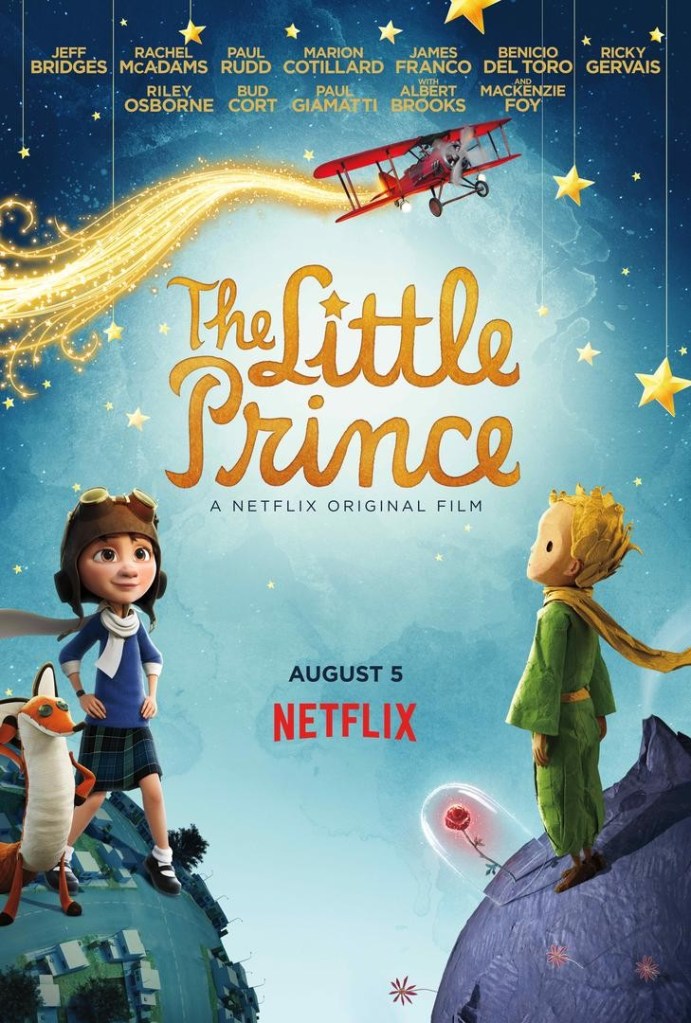
Speaking of Vladimir Propp’s 8-character types, some characters act as more than one while some are symbolic characters.
The Hero – Little Girl, a smart, feisty and precocious girl with a kind heart. She has a very inquisitive mind and struggles to balance growing up and basking in her childhood.
The Aviator as various characters e.g. the Father and the donor. The Aviator, an eccentric and retired aviator who befriended the Little Prince in the Sahara Desert and acts as a mentor to the Little Girl.
The False Villain – The little girl’s mother, who organises her entire life according to her will and is an absentee parent.
The Villain – though there are not any such villains in the story but I regard as time itself being one. One of the messages given in the film is ‘Growing up is not a problem, but forgetting your childhood is’.
The False Hero – The little prince an eternally young boy and resident of “Asteroid B612”, a small asteroid roughly the same size as him. The adult version of Little Prince who has forgotten his own childhood and becomes an anxious, incompetent janitor for the Businessman.
Levi Strauss’ Binary Oppositions
The film clearly makes it about Childhood VS Growing Up, or more precisely Little Girl VS society that dictates her life. The film is resolved as Little girl realises what it means to be a kid and enjoy the moments of life.
Todorov’s narrative model
The film follows a linear narrative. Has an equilibrium that is upset when the girl starts to feel that everyone is alone a one point or another. She embarks on a journey to find the Little Prince and set what is meant to be. She realises the purpose of life and this creates and new equilibrium in turn.
References
Media, A. C. o. C. a. t., 2016. Raising Children. [Online]
Available at: https://raisingchildren.net.au/guides/movie-reviews/the-little-prince
 Arsalan Awais