
This week we talked about Semiotics. A very vague topic and has different schools of thought about its definition. It’s a very big concept, and there’re many strategies for semiotics, one of which is painting. Therefore, I’d like to discuss Realism through the work of an impressionist painter Edward Hopper (1882) famous for Nighthawks.
Realism, in philosophy is a perspective that grants things that are known or observed an existence or in nature that is unaffected by who is thinking about or viewing them.
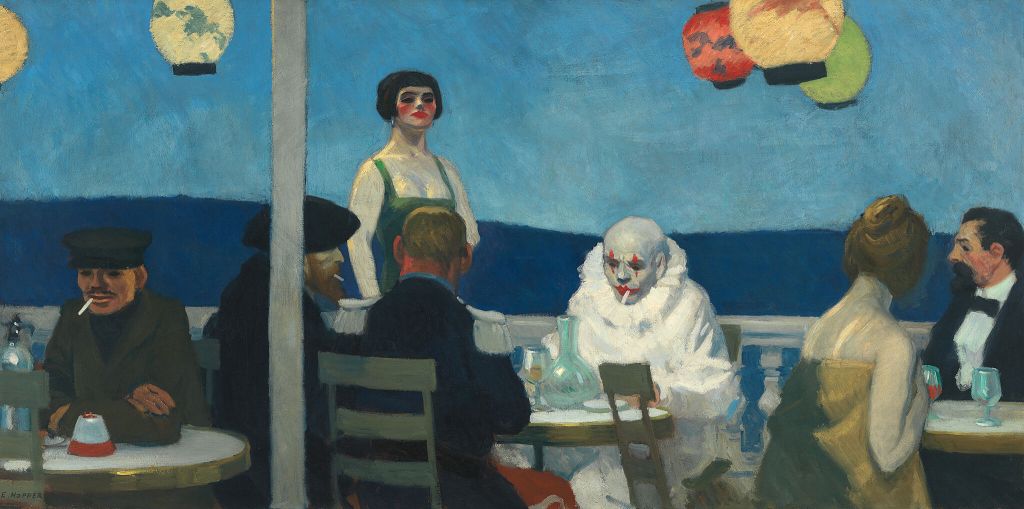
The following is the painting Soir Blue (1914) or Blue night. The painting is more grounded than it looks. The focal point is a white clown in his stereotypical white puffy clothes and is following the myth of being a depressed and smoking. This is the connotation and myth that a clown is a symbol od fepression and two faced. One face/personality that he shows the world (his happy side), the other he is in actuality (the depressed side).
The Denotion here is the way people of certain stature are supposed to dress. If you observe the people around it tells you different stories, they all emit e.g. the way the people are dressed highlights a stature in class. The couple on his right are much disturbed by his smoking and appearance or act. Across from him are two other interesting characters: judging by the patches on his shoulder one seems to be a military officer in full uniform and bearded man dressed in black is visually similar to Van Gogh.
The women behind could either be a waitress or another customer at the restaurant, has a haughty posture and looks down at the clown. The bloke on the far left of the painting sported in mud colour seems to be indifferent of the situation. It is worth noting the colour scheme of the people in it. Colour depicts character traits.
The setting itself is a vital character, to justify the story. Some might say it is a restaurant, while some a café but the Chinese lights suggest something else entirely. All in all, it can be agreed that story is about loneliness and how alienated one can feel. It also tells about how one feels the society perceives him or how one is fooling his way through life.
That’s the beauty of this piece that it can be depicted in as many ways as one wants. Regardless of these interpretations the painting tackles and everlasting concept.
References
Anon., n.d. History of Art. [Online]
Available at: https://www.thehistoryofart.org/edward-hopper/blue-night/
Britannica, T. E. o. E. o., 2022. Britannica. [Online]
Available at: https://www.britannica.com/art/Impressionism-art
Jones, J., 2020. The Guardian. [Online]
Available at: https://www.theguardian.com/artanddesign/2020/feb/12/meet-vincent-van-gogh-experience-review-south-bank-london
Stanska, Z., 2018. Daily Art Magazinne. [Online]
Available at: https://www.dailyartmagazine.com/painting-week-edward-hopper-soir-bleu/
Stevens, M., 2010. New York. [Online]
Available at: https://nymag.com/guides/fallpreview/2010/art/67616/
White, M., 2018. The Enlighment. British Library.
 Arsalan Awais