Using the theories of extended reality, I will break apart my own work and analyze it through the lens of Extended reality to see if it becomes more effective, what could be gained from using the medium and are there any risks.
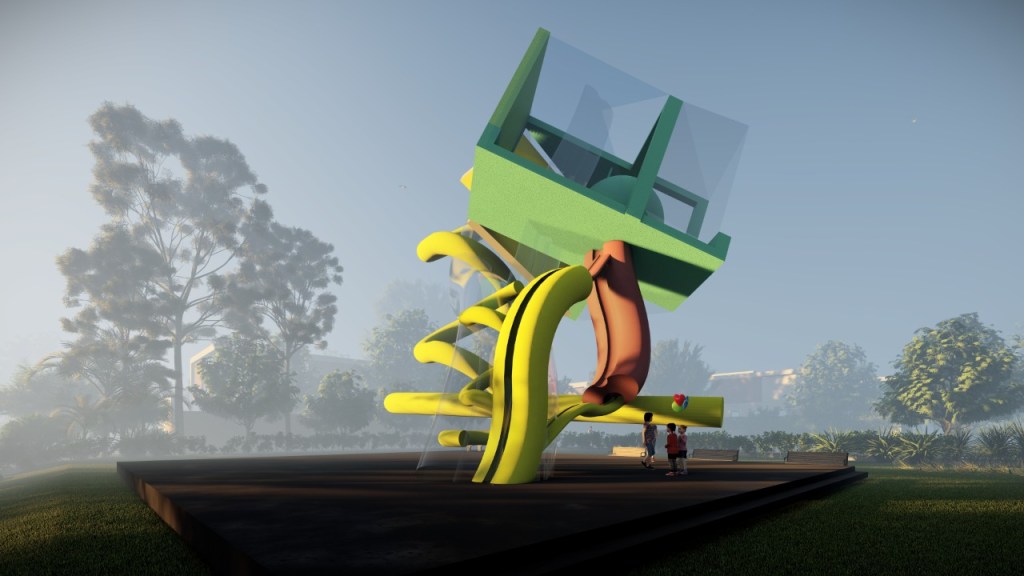
Below is a project I worked on for IAPex (architectural design conference). We were required to create a sculpture that was a combination of; Futuristic, Continuity and Boldness. After various ideation, I realised an abstract way would be much suited and it did not need to be grounded in reality.

A breakdown of the aspects;
Continuity
In this spiral form, I have showed continuity through different volumes at different levels to portray complexity through continuous form and ideation. I wanted it be a somewhat linear as that is what I wanted it to be associated with

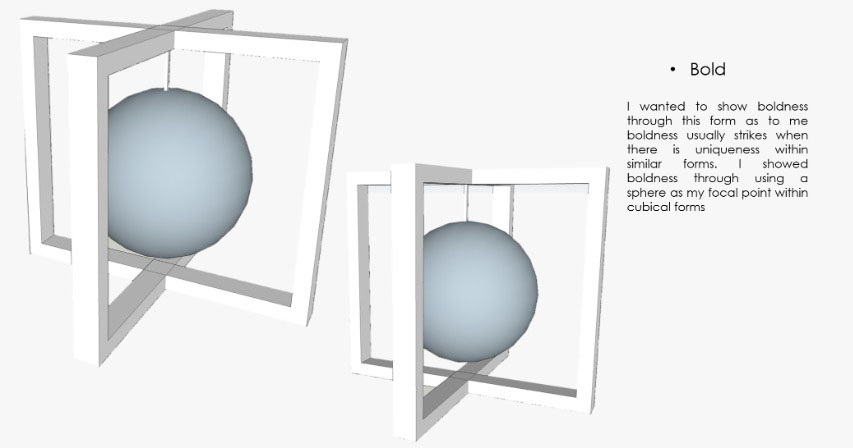
Boldness
I wanted to show boldness through this form as to me boldness usually strikes when there is a uniqueness within similar forms. I showed boldness though using a sphere as my focal point within cubical forms.
Futuristic
In this form I have showed a futuristic form through not taking its structural capability and gravity as elements affecting it.
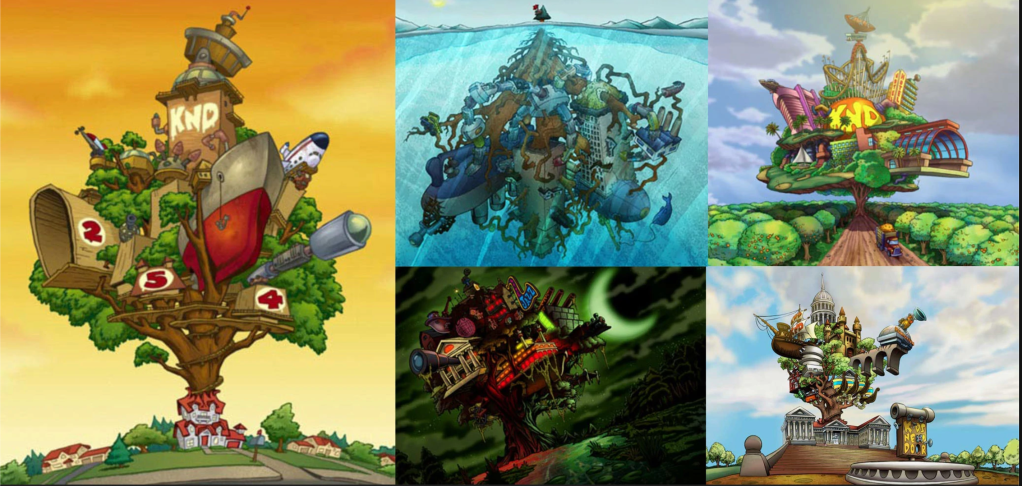
The final form looked somewhat like this. I achieved my final architectural form by combing all three of my forms and using the push and pool tool to create planes and different levels so that I could obtain apertures and play of lights and shadows. If one would observe the design is similar to a child’s play house and inspired by the animated series KIDS NEXT DOOR.

How it is related to my work?
My work is mostly palyfull and ambitious. In the sense that, I try to empathise with children, their imaginations and traits.
How it could be enhanced with VR/AR/MR. What would it gain from extended reality?
When using ER, Baudrillard’s 4 phases of the image come into play and are key factors. Those being:
Phase 1: Images as a reflection of reality
Phase 2: Images as masking or perverting reality
Phase 3: Images as masking the absence of reality
Phase 4: The image “bears no relation to any reality
whatever”
Architects now days are relying on Extended reality to give the clients and spectators a more feel of what they are trying to create and with a rapid advancement in technology it is only going to get better. Since my project is mostly theoretical, Extended reality would help me in pitching the idea and give the audience a much better feel of it inside and out. Not only that, if they get a sense of warmth with it, for sure the idea would be hot and people would want to invest and could the start of an artistic movement. The work could be “total work of art”.
Another thing that could be gained is when for example it goes into production, the team/labour can be trained. A production outline can be achieved. It wiuld offers a safe and realistic training environment. Where the technology costs, risks of injury, and costly damages to equipment can be eliminated. Extended Reality training provides trainees with safe experiences of scenarios.
What is the risk?
The biggest risk is that, the actual thing might not play out as similar to the simulation. The technology is not budget friendly and in its current stage it might be not that convincing.
Final Thoughts Sure ER could be used as complementary tool to just sell the idea, and to run simulations as to how the materials would work out and play off each other but nothing more.
References
Baudrillard, J. (1983) Simulations. New York: Semiotext(e).
 Arsalan Awais