Development and Experimentation | Update# 9

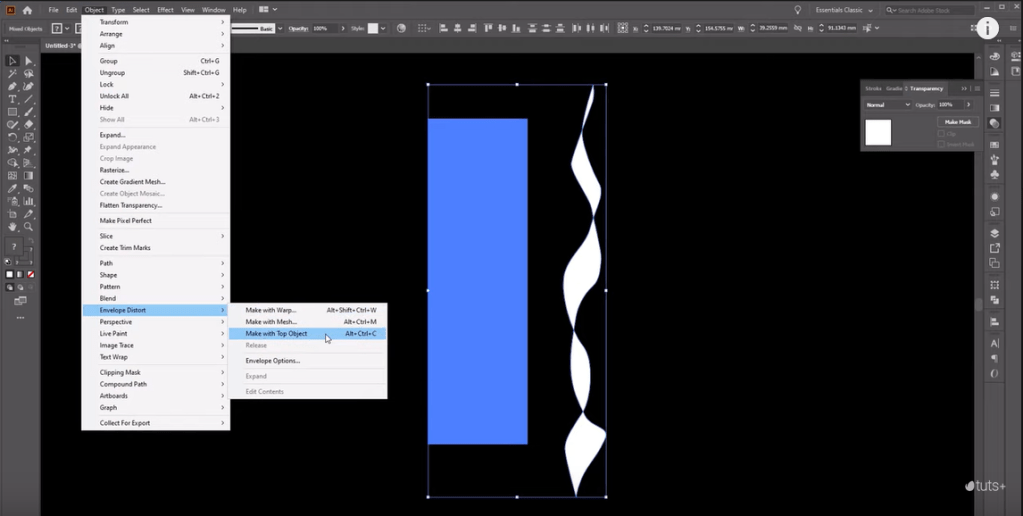
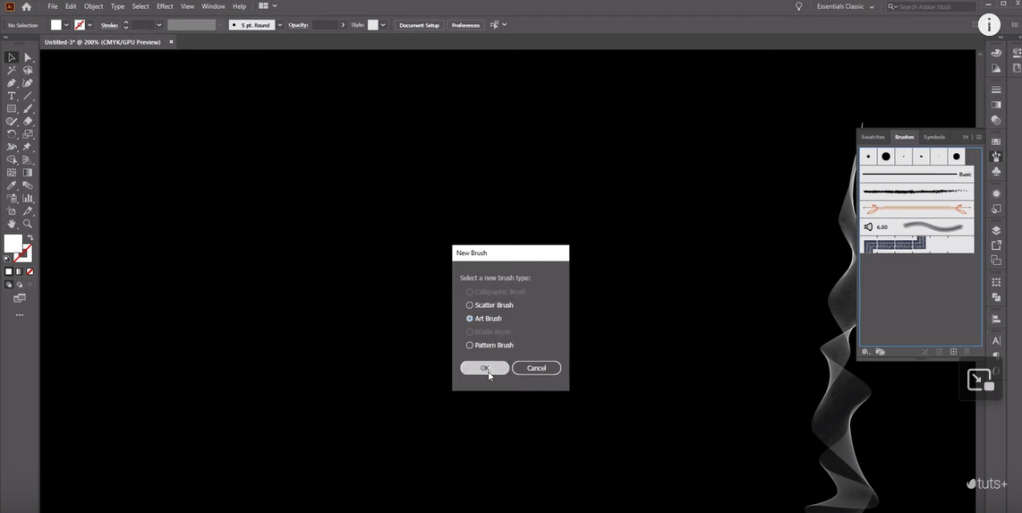
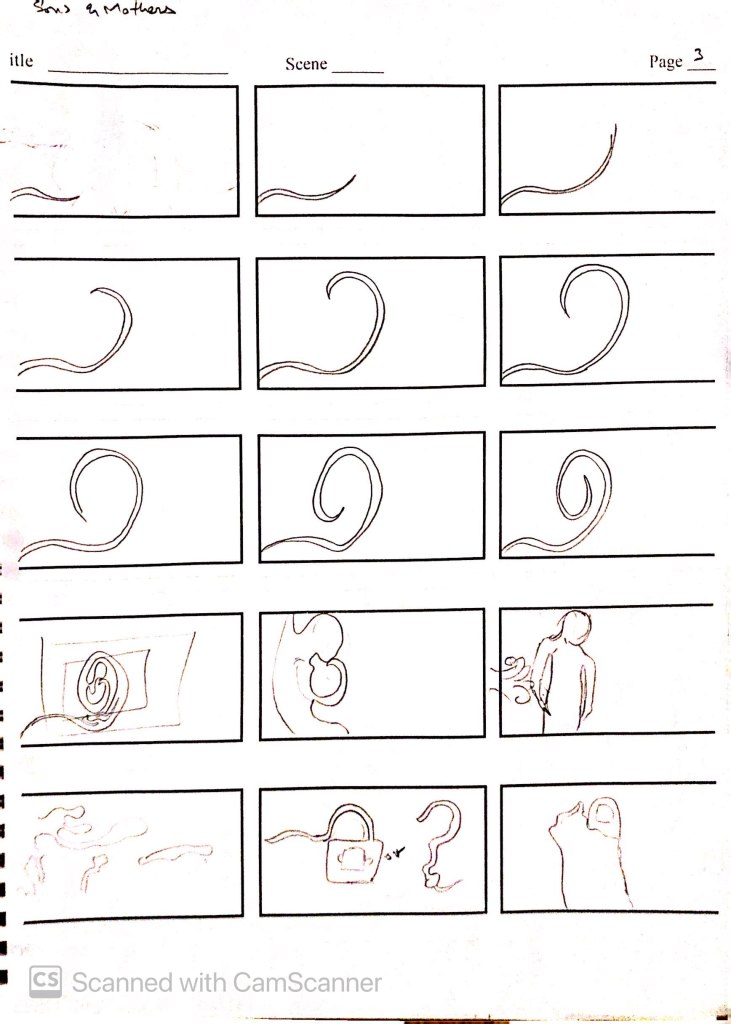
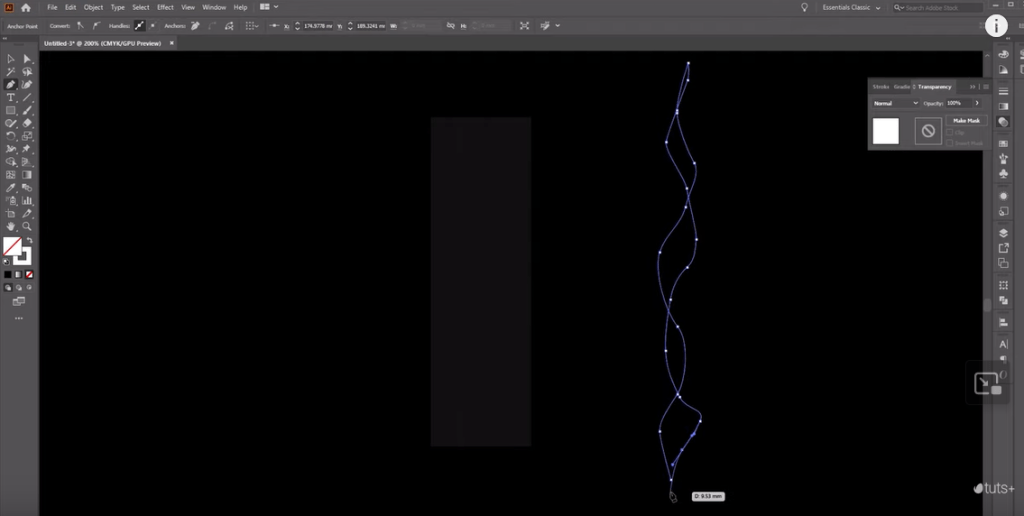
The most tedious task was to design the opening sequence, where the smoke trail transforms into the animated title sequence. I tried experimenting with a couple of smoke brushes in Photoshop but failed miserably. After spending time online researching, I found out I can create my own brush in Adobe Illustrator.

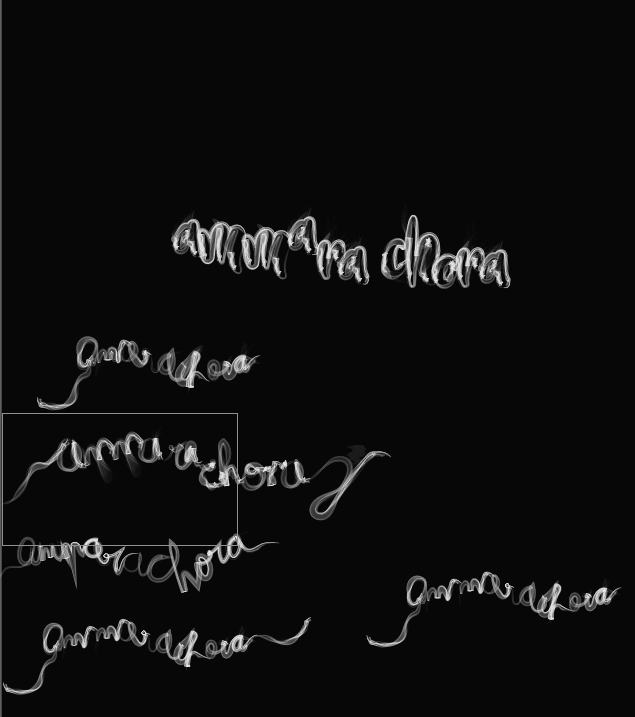
Since I wanted the poetry animation to be culturally authentic, I chose the hindi word for sons and mother “Ama ra Chora”.

After much ideation, I moved on further to actually animating it using this brush. But before this I had to block out the scene.

It is oddly satisfying to see, the smoke trail come-together. If I add a bit of box blur to this then it will help sell the effect even more.

References

http://www.youtube.com. (n.d.). How to Make an Illustrator Smoke Brush. [online] Available at: https://www.youtube.com/watch?v=FDbsV6OwBpU&t=381s [Accessed 23 Apr. 2023].

Decision Making | Update# 8

Taking into account the feedback of the initial animatic, I revised some scenes and added a bit of depth to some. Halfway through, I realized that animating a smoke trail throughout the video would be a challenge, and need to devise a different approach.

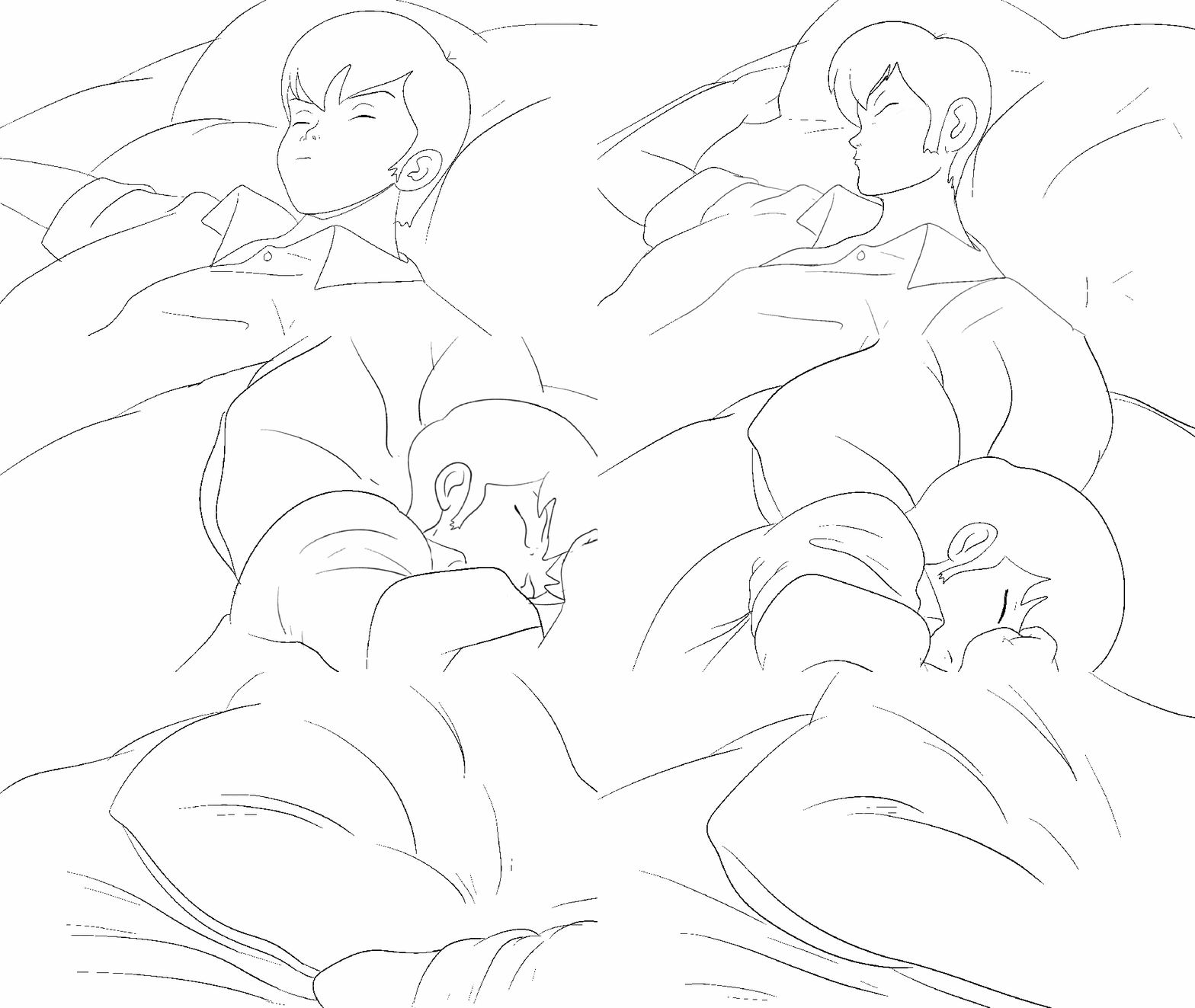
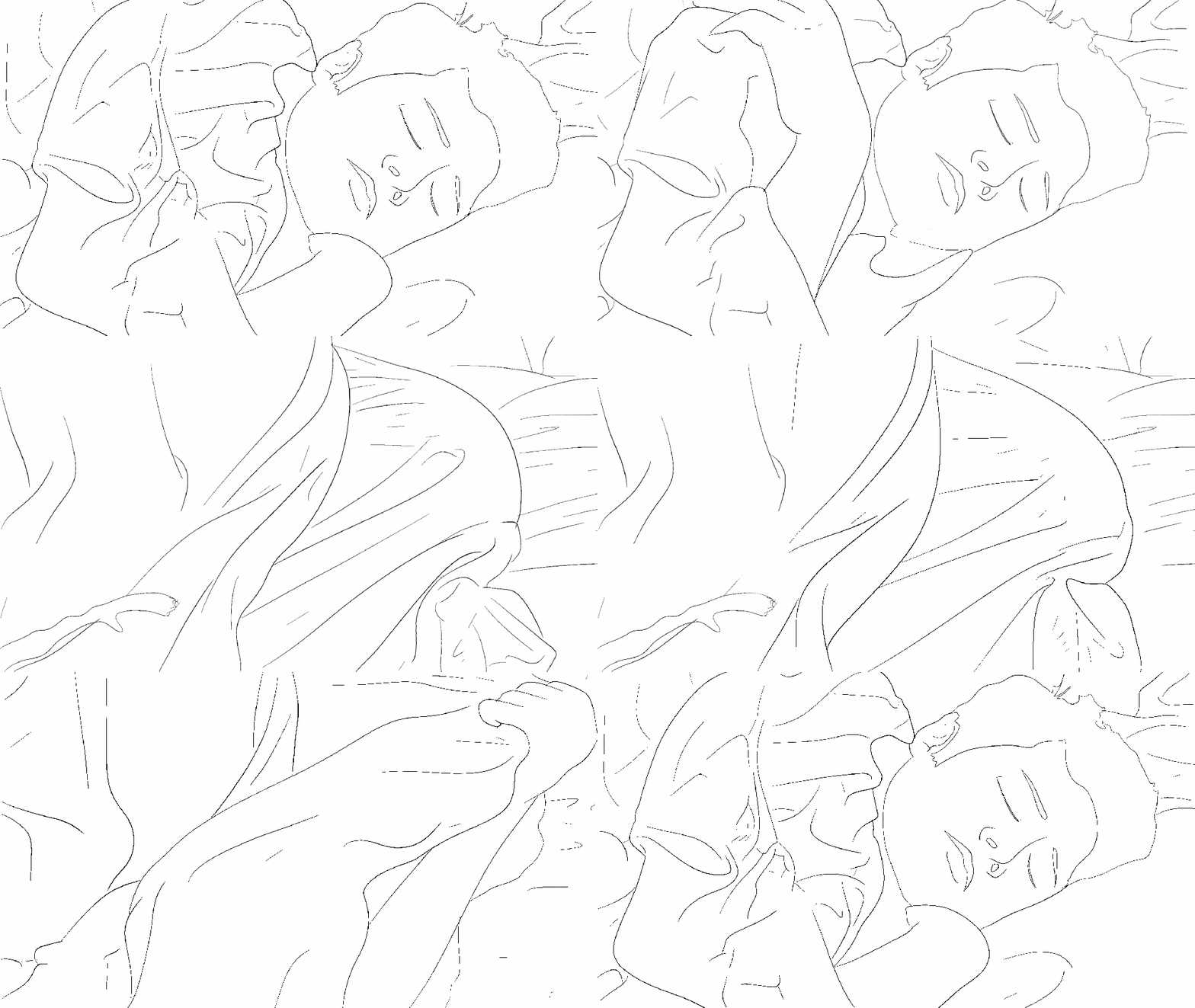
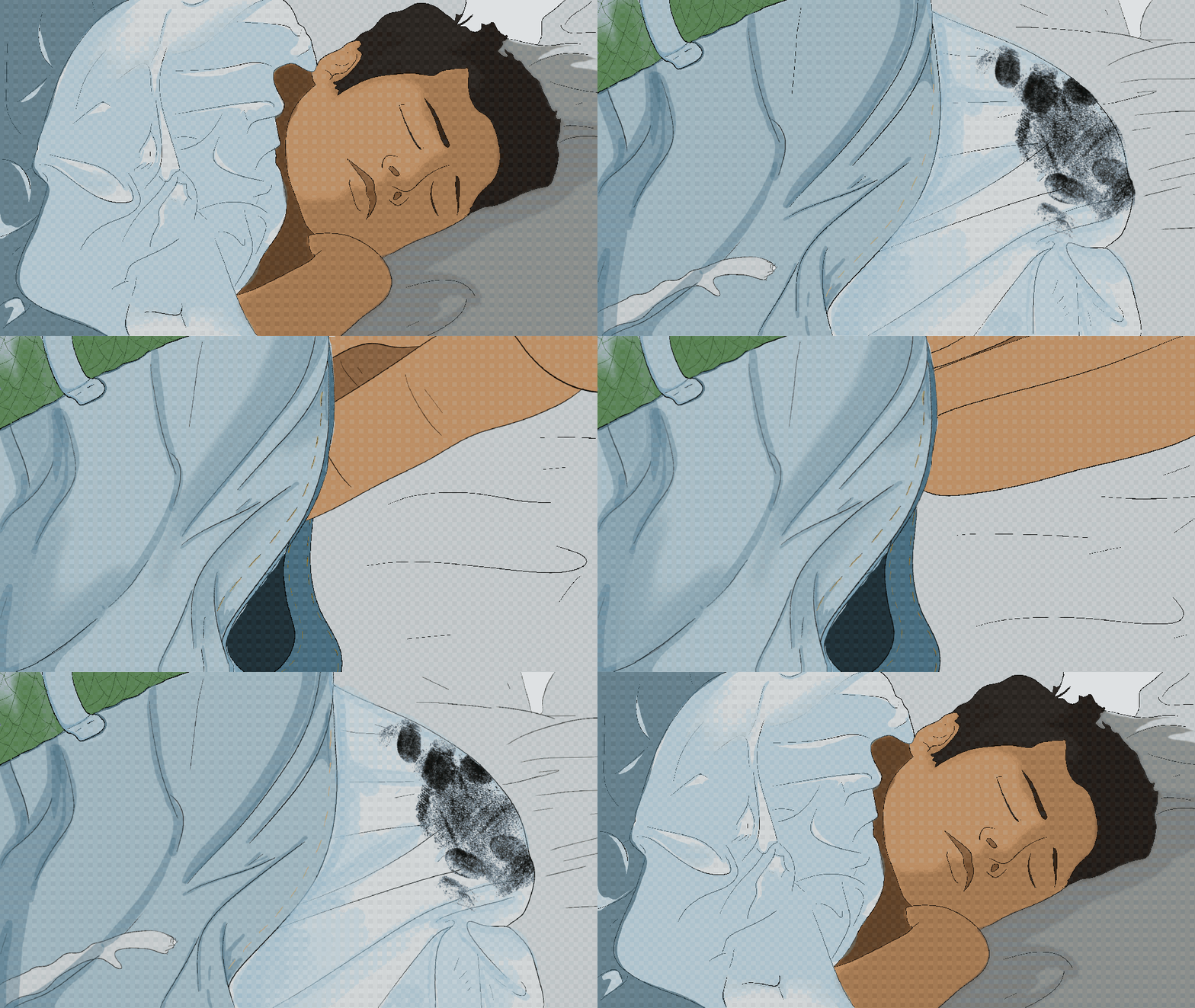
I started animating rough scenes where the words did most of the work and the images were allowed to roam freely.

The above is a sample animation for the part;

Sleeping on my mother’s bed, at my age, doesn’t feel so strange. It is warm.

The above is a sample animation for the part;

Sons are the fingerprints of hands hidden in pockets. They need the need to be kept a secret-

The animation was a bit jerky and so I added a couple of in-betweens and further extended it to amplify the words. I added some fingerprint details and half-way through I started adding base colouring to find the look and feel of the scene.

Experimentation | Update# 7

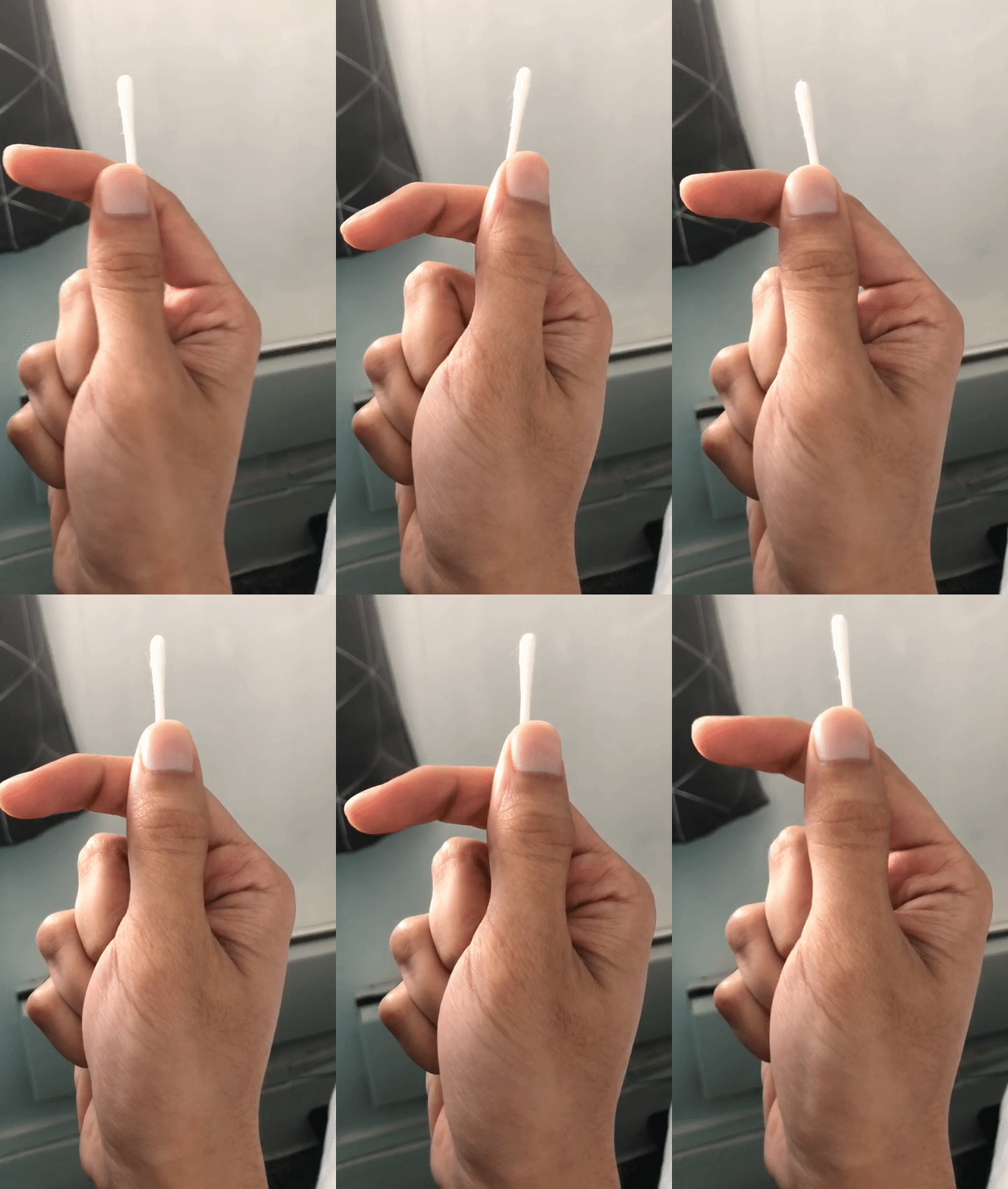
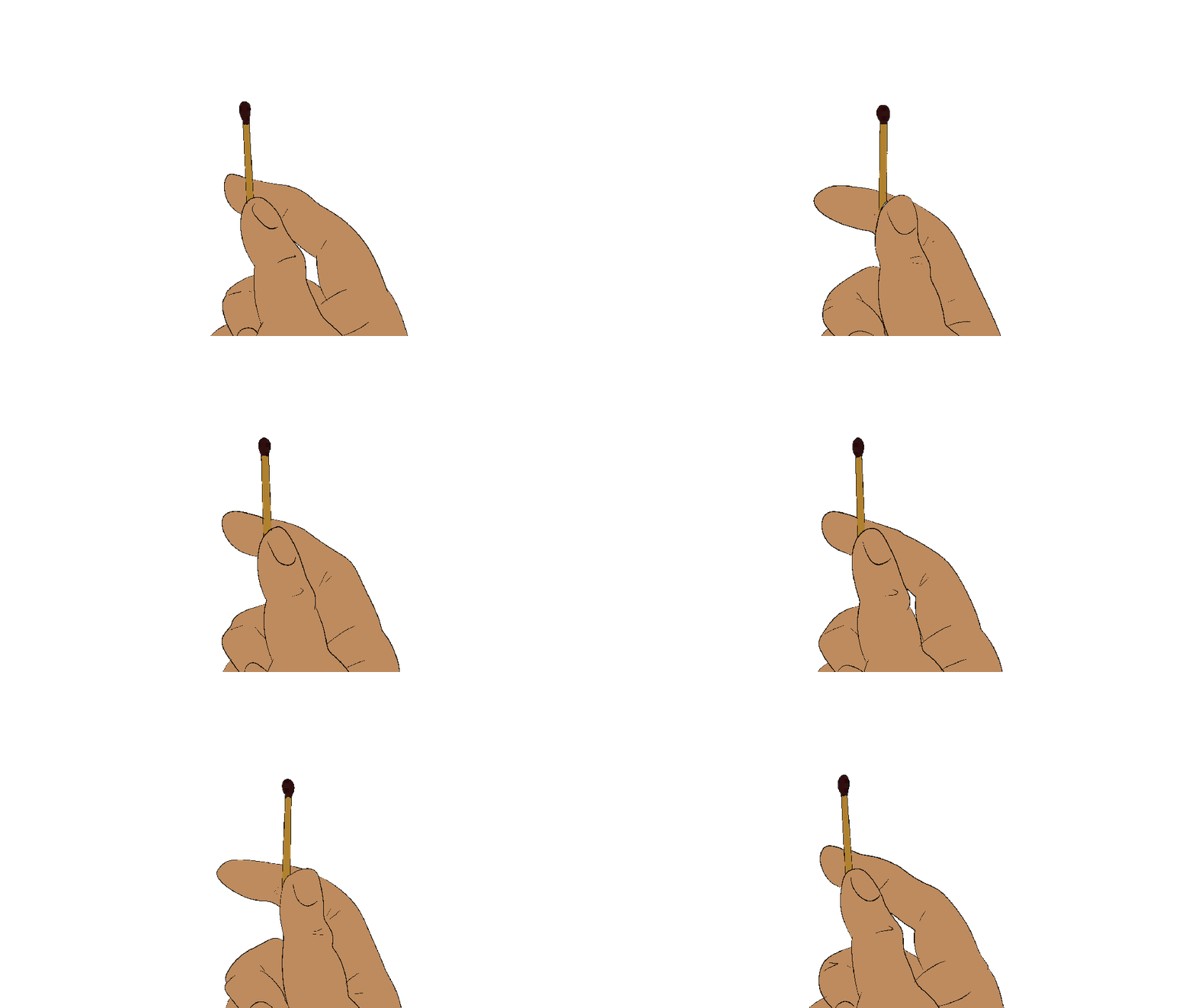
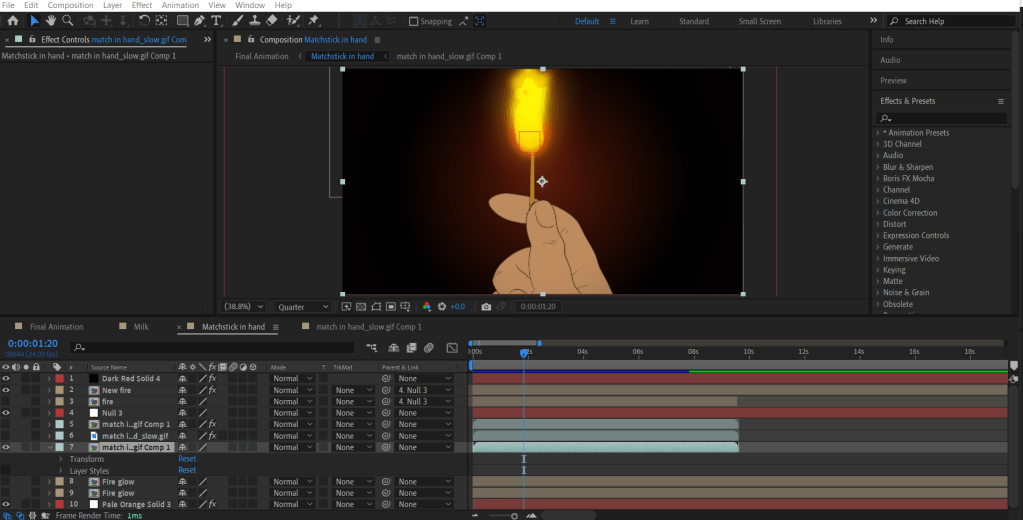
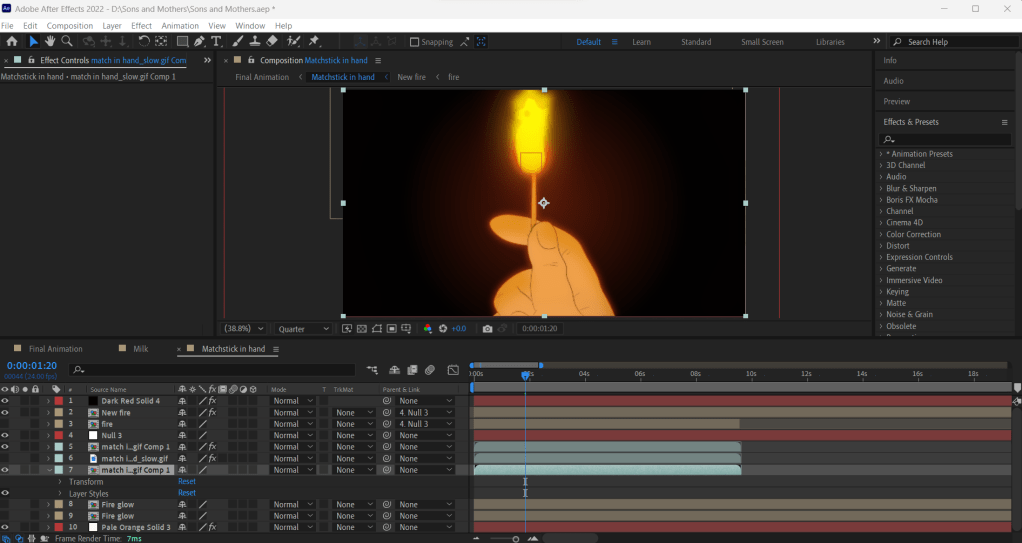
As stated before, since diya is an essential plot device, the fire animation needed to be very fluid and I tried a test animation, where I roto-scoped my hand movements.

Firstly, I recorded a video of my hand doing the exact movement that I wanted. For the skin tone I went with an Olive green texture as it is the most common skins colour of the Asians. The matchstick top had to black as well, for the burnt effect. Next after tracing it and colouring it in procreate, I animated it using after effects.

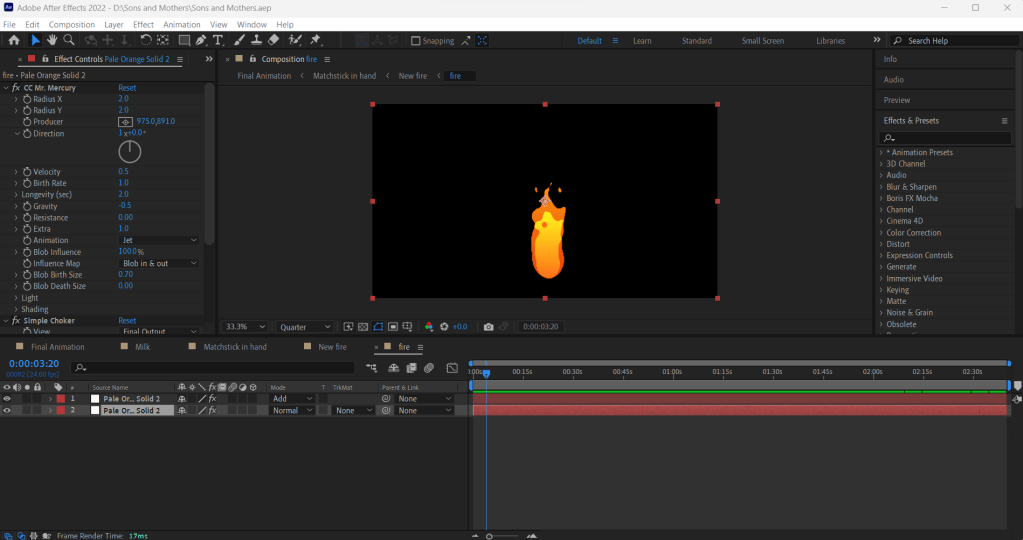
At first I wanted to draw the fire frame-by-frame but decided on making it digital. I found the perfect tutorial for this on YouTube, where an effect called CC Mr. Mercury helped me achieve. To add a bit of grainy effect I applied a simple choker and to sell the effect I added a combination of box blur and cc composite.

When ever you are dealing with a light object there is always ambient light on the respective object that is dealing with it. In order to do this, I fiddled around with drop shadows and the glow effect and after a few hours I was able to achieve this.

Overall, I am quite happy with what has turned out and this experimentation has given me an idea of the overall tone of the animation.

References

http://www.youtube.com. (n.d.). Procedural Fire in After Effects (NO PLUGINS!). [online] Available at: https://www.youtube.com/watch?v=yZvgXpemGzw&t=522s [Accessed 23 Apr. 2023].

Initial Feedback and Reflection | Update# 6

When I presented the animatic in todays lecture, I got a mixed response. For some the animation had a very linear story but gets confusing after a certain point, a bit incoherent. For some the closeup shots gave it a suffocating feel and should had some long shots to break this suffocation. One of my teachers felt that the story lacks the essence of the mother, so I need to register her through various means.

After the feedback I also realised the story was half baked and I need to add some more scenes and revise the story a bit to make it more coherent and linear. Since the poem does not tell, if the mother is alive or not, I have to bring her empathy into the story and make it a bit more relatable and dramatic.

Development | Update# 5

This time around I used Photoshop to create a rough animatic as I kept tweaking the frames throughout. When I added the sound I realized I was lacking in some scenes and one thing I barely achieved is the timing. For now I am quite satisfied with what I made but I think I can polish some scenes further, but I will know for sure after the lecture.

Decision Making | Update# 4

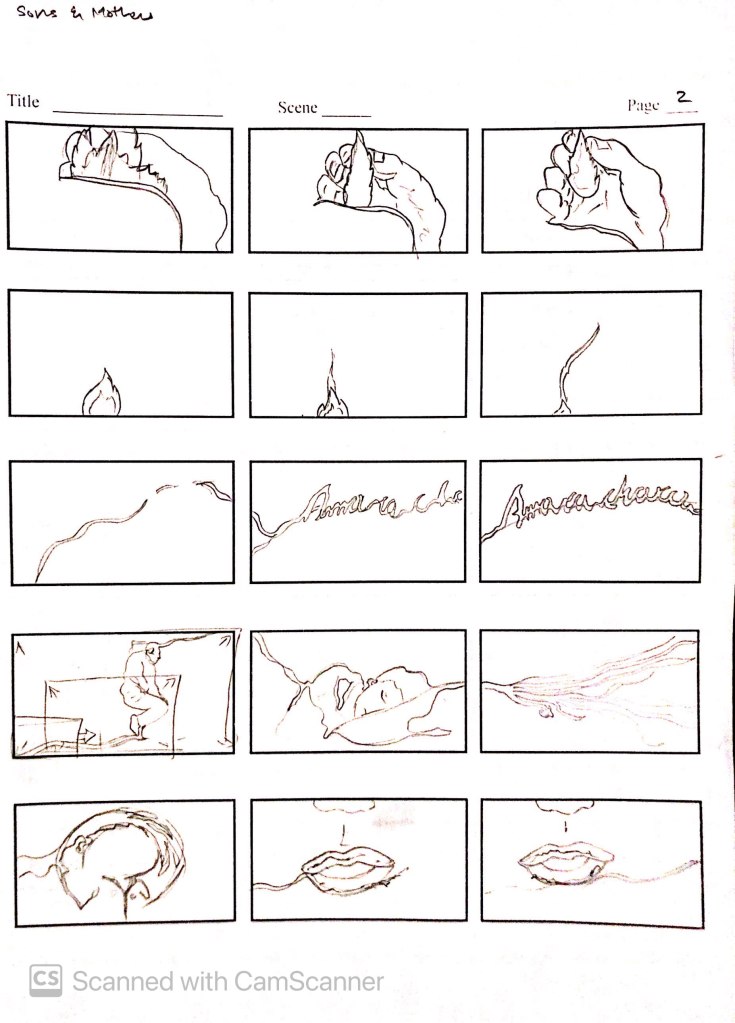
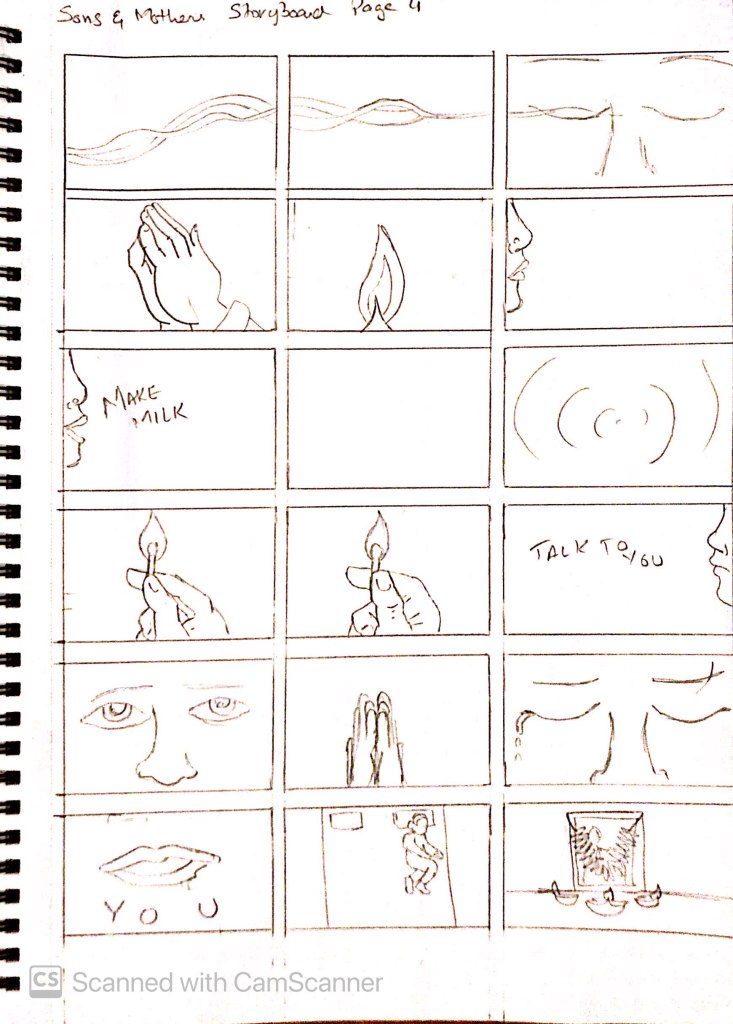
Story boarding

I felt the poem had a very uneasiness feel to it. I added a couple of frames in the story to set up the theme and poem e.g., the Diya plays a very important throughout the story because it is an essential object used when praying for the departed soul. Although it is not clear if the mother had died or not but is built around her essence. For the majority of the story we had more closeup shots and as we are traveling and tracking the smoke trail, it transitions from one thing to another. Another reason I chose such shots is because I wanted to go for a grim, dark and uneasy aesthetic.

Development | Update# 3

Upon reading the poem a couple of times I go the sense that there is more than meets the eyes with this one. It seems as though the mother is dead and is written in her remembrance, but after an in-depth discussion with the poet I realized that it was more about how as a child our mothers smother and pamper us. When we get older, the things we did as children have become uncomfortable, but there is a loss in this experience, as well as a nostalgia and comfort. The striking match comes from the moment when the poet’s mother and him used to pray in a small temple, in their home, by lighting a diyo (which I is a plot device and will be basis of the whole story). I think growing up is like being in prayer, so much of it is in secret and by yourself. But overall, the poem is about trying to figure out what it means to be a son growing up and getting further away from my mother, yet still hoping for an closeness that is lost when growing up.

When researching other poetry animations I came across a familiar one that we were taught in our o-levels called “o des se aane wale bata” by Pakistani Poet “Akhtar Shirani”. There is a striking similarity between the two in the sense that both talk about lost times and want a chance to to relive those memories. Although the meaning might be different but tonally are same.

Below is an excerpt from the poem “o des se aane wale bata“. In these couple of lines the poet reminisces about this homeland e.g.,

کیا اب بھی وہاں کے باغوں میں مستانہ ہوائیں اتی ہیں ؟
کیا اب بھی وہاں کے پربت پر گھنگھور گھٹائیں چاہتی ہیں ؟
کیا اب بھی وہاں کے بر کھائیں ویسے ہی دلوں کو بھاتی ہیں ؟

Which translates to; him asking about “do the those warm airs in the lands still exist?, Does the sound of music still exist?, is the land still green?”

Hence, without drifting away from the task at hand, I devised a concept for the animation. Since the diya (a pinhole candle made of mud/ceramic) plays an essential part in the story, the concept revolves around it.

Concept

We are in a dark room and we see someone lighting a match. A hand appears from the pitch dark and lights a diya. We start to follow the smoke trail from the candle fire. The smoke itself is a character and it keeps transforming in to different objects. Not only this but the smoke is traveling throughout the room and showcasing what a mess the son is. The smoke trail in a way acts as our camera and travels 360 degrees in the room and connects back in to the fire from where it first emerged. We cut to a shot of a picture frame that contains a portrait of him and his mother (as this symbolizes that he is mourning lost times). There is a flower necklace around frame, similar to Hindu tradition when they mourn the departed.

Once I start story boarding only then I will get a sense of what the smoke and environment would look like.

References

Rekhta. (n.d.). Read full nazm by Akhtar Shirani. [online] Available at: https://www.rekhta.org/nazms/o-des-se-aane-vaale-bataa-o-des-se-aane-vaalaa-hai-bataa-akhtar-shirani-nazms [Accessed 22 Apr. 2023].‌

Wikipedia. (2023). Akhtar Sheerani. [online] Available at: https://en.wikipedia.org/wiki/Akhtar_Sheerani [Accessed 22 Apr. 2023

Research | Update# 2

Before I started my ideation, I wanted to take a look at what had been done in term of poetry animations i.e., what type of visual story tellings were effective e.g., literal or symbolic ones. One thing that was clear from the very beginning was that no matter what approach I take I have to justify the source material while giving my own rendition.

Death and Mother by Robert Lingford (1997)

It is a Black-and-white, etched-wood animation tale about the Grim Reaper. In a remote forest, Death in disguise calls on a woman and her baby daughter. When the mother realises the identity of her visitor, and his intention to claim her child, she tries to flee the inevitable. Of course, try as she might, she cannot evade Death. Eventually, she accepts her fate when confronted with a window into her future. It is actually a short film that aired on Channel 4, but the concept is remotely similar my poem. The major selling points of this film are the transitions and I might take a note from this one in term of keeping the audience engaged through such means.

Jabberwocky by Lewis Carroll (1871)

Lewis Carroll’s “Jabberwocky” is a nonsense poem (from the 1871 novel “Through the looking glass”) in which many of the words are invented out of the author’s imagination. As a result, readers depend on Carroll to explain the meanings of such words. The story recounted in “Jabberwocky” is, at its heart, a very traditional heroic narrative in which an unassuming hero sets out to defeat an improbably dangerous enemy. For this reason, the boy’s success in slaying the Jabberwock evokes the most classic theme of heroic narrative: the triumph of good over evil. The animation is done at 3s (8 frames-per-second) with a stop motion and type feel. You can notice that there are moments when the words are independent of the imagery and this allows a more fluidity in the animation and I believe that a points where a more abstract approach is taken it turns out more effective.

“Humans” by Meghann Plunkett

The speaker boasts of human sophistication while addressing a silenced goldfish. It represents a sentiment of the vulnerable or the often unheard. It reveals a sense of arrogance in the human so boastful, impressed by human achievements and privileges, until midway through, the speaker flips the poem upside down. It encourages humility while exposing human fragility from the perspective of God looking at us as if we are now the goldfish. The poem confronts our assumptions about humanity and encourages us to ponder our perspective of self-centered importance in the universe. In this animation an additive combination approach is taken i.e., where the words amplify or elaborate on an image or vice versa.

“The World” by Rumi, A Poetry Film by Ella Dobson

The animation is made on the teachings of Rumi and a very challenging to animate as well because works by Rumi are so multi layered that there are many ways to interpret it. The above animation is very abstract and implies the method that, the more is said with words the more the pictures can be freed to go exploring and vice versa. Hence it relies on very crafty transitions.

In most of the animations I saw all of them either had an additive combination or Independent combination and one thing that was common throughout was that all employed crafty transitions when changing scenes (or lines) and these methods keep the audience engaged.

References

http://www.youtube.com. (n.d.). ‘How to Be Alone’ by Pádraig Ó Tuama, A Poetry Film by Leo G Franchi. [online] Available at: https://www.youtube.com/watch?v=HgZT6UJocRs.

http://www.youtube.com. (n.d.). Meghann Plunkett – ‘Humans’. [online] Available at: https://www.youtube.com/watch?v=iP_xG0TiSD8 [Accessed 9 May 2021].

http://www.youtube.com. (n.d.). Lamya’s Poem | Official Trailer. [online] Available at: https://www.youtube.com/watch?v=0rtVkvAkgEc [Accessed 22 Apr. 2023].

‌www.youtube.com. (n.d.). The Country – Billy Collins Animated Poetry. [online] Available at: https://www.youtube.com/watch?v=8xovLpim_1s [Accessed 22 Apr. 2023].

‌www.youtube.com. (n.d.). South – A Visual Poetry. [online] Available at: https://www.youtube.com/watch?v=P4T1Lpx3pNI [Accessed 22 Apr. 2023].

‌TED-Ed (2020). ‘Jabberwocky’: One of literature’s best bits of nonsense. YouTube. Available at: https://www.youtube.com/watch?v=GLQos7-Vq8M.

http://www.youtube.com. (n.d.). LA MADRE Y LA MUERTE (Death and the Mother) Ruth Lingford, 1997. [online] Available at: https://www.youtube.com/watch?v=AR5zJrP0JkQ [Accessed 22 Apr. 2023].

Poetry Brief | Update# 1

For the this semester we were given a project in which we were to create a 90 second animation based upon a poetry. The poetry project is a collaboration between the MA Animation students and the Poetry Society.

The Poetry Society

The Poetry Society is a charitable organisation, that provides support, information and merchandise for specialists and the general public. They engage with and support diverse poetry audiences. Founded in 1909 to promote “a more general recognition and appreciation of poetry”. Since then, it has grown into one of Britain’s most dynamic arts organisations, representing British poetry both nationally and internationally. With more than 5,000 members worldwide, it publishes the UK’s leading poetry magazine, The Poetry Review, which has been published since 1912. With innovative education and commissioning programmes and a packed calendar of performances, readings and competitions, The Poetry Society champions poetry for all ages.

Sons and Mothers (Ama ra Chora) by Mukahang Limbu

Sleeping on my mother’s bed, at my age, doesn’t 

feel so strange. It is warm, and the pillow 

smells like her hair. The blanket, her embrace. 

                                                                        ***

Sons are the mustard sweat stains on white collars. They need to be hand washed-

Sons are the skin hanging off sun-soaked lips. They need to be snipped with teeth-

Sons are the fingerprints of hands hidden in pockets. They need the need to be kept a secret-

Sons are the holes in orange socks. They need to be mended and sewn together as a closed mouth

***

I pray to God 

With a candle-

A wax pinhole with the face of the Moon.

Mother says,

Make milk.

I bathe my hands in the white.

Mother, makes me

Strike a match.

It burns like secrets spoken for the first time.

(My secret is that I always want to talk to you…)

I am a child that chases lost voices.

***

In front of God I am shy.

                                                I clasp hands.

                                                                                Sometime I even cry.

                                                                                                                                Because I ask.

                                                                                                                                                                For.        

    You.

Sleeping in your bed, at this age does not feel so strange, because that’s where I was born. In your arms.

Poets Explanation

I don’t remember the context of the poem, but I had written it during a time when I was growing up, and becoming my own person, outside of my relationship with my mother. It is thinking about how as we get older that the things we did as children have become uncomfortable, but there is a loss in this experience, as well as a nostalgia and comfort. The striking match comes from the moment when my mother and I prayed to our small temple, in our homes, by lighting a diyo. I think growing up is like being in prayer, so much of it is in secret and by yourself. But overall, I think I’m trying to figure out what it means to be a son growing up and getting further away from my mother, yet still hoping for an closeness that is lost when growing up.

References

poems.poetrysociety.org.uk. (n.d.). Sons and Mothers – The Poetry Society: Poems. [online] Available at: https://poems.poetrysociety.org.uk/poems/sons-and-mothers/ [Accessed 22 Apr. 2023].
The works of Sylvain Chomet | Reflection on other practitioners

Sylvain Chomet might not be your traditional animator or artist. Being a huge fan of ‘The Simpsons’, I found out about him when he created the couch gag opening for The Simpsons. He is one of the few artists that use real life figures and use their caricatures as characters. I never imagined what real-life caricatures of the characters would look like. his visual style convinced me that the Simpson characters are inspired by real people, not simply random characters, and that they are a part of us as well.
He stylizes caricatures like they belonged to the 1920s but with a modern touch which gives his art style a very unique touch. He places these characters in modern environments, buildings, etc.

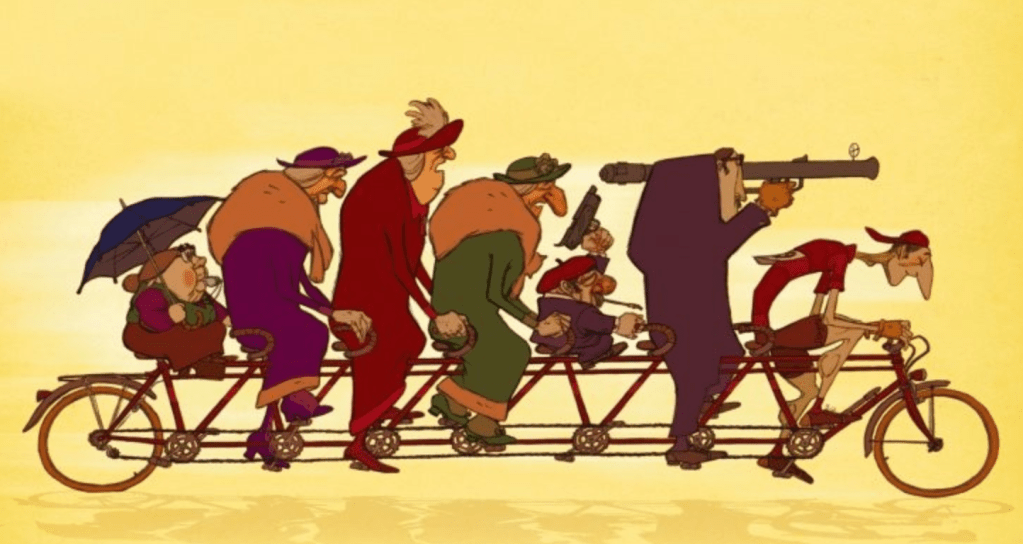
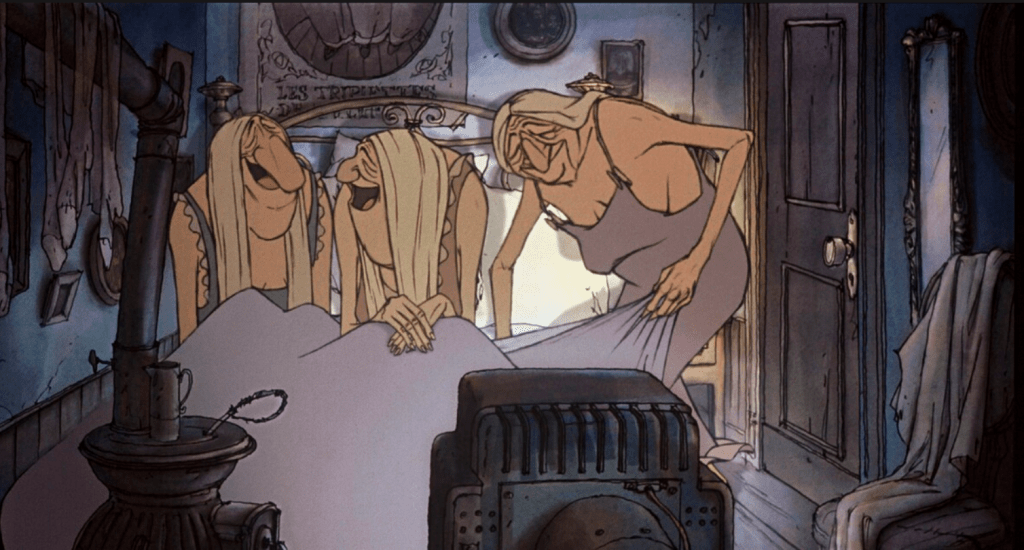
I admire Sylvain Chomet’s film The Triplets de Beville, and one of my favourite aspects of the film is the character design.
What makes his work avant-garde and his narrative so effective, despite the fact that they are silent pictures is what intrigues me.
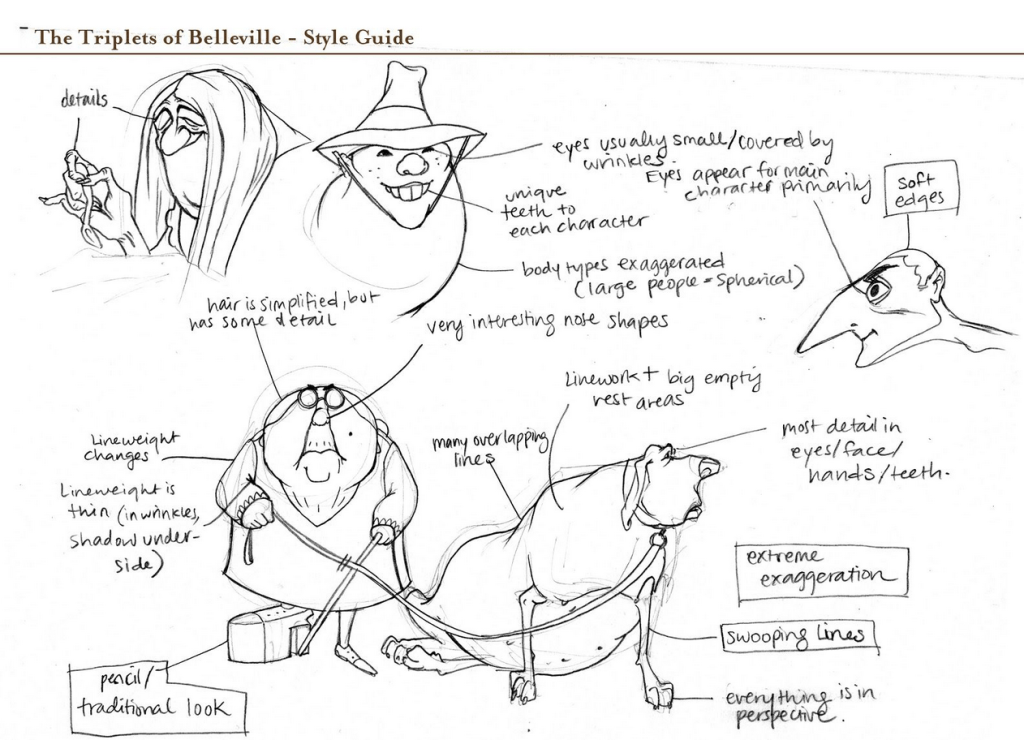
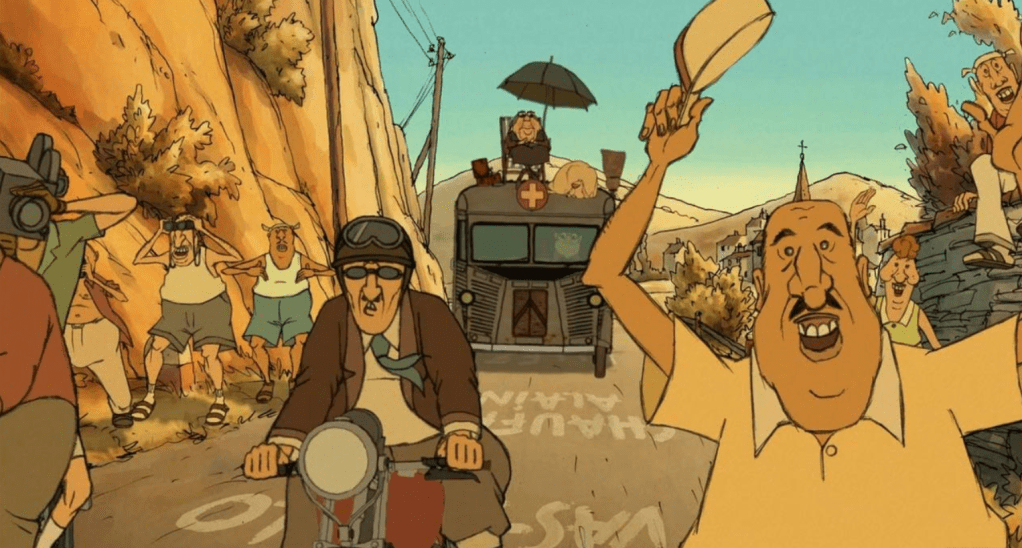
All the characters are very exaggerated e.g., so huge noses, long legs, a particularly very fat dog with the features of the characters are so exaggerated that is almost satirical and these characters are full of flaws and this is what makes them so lovable.

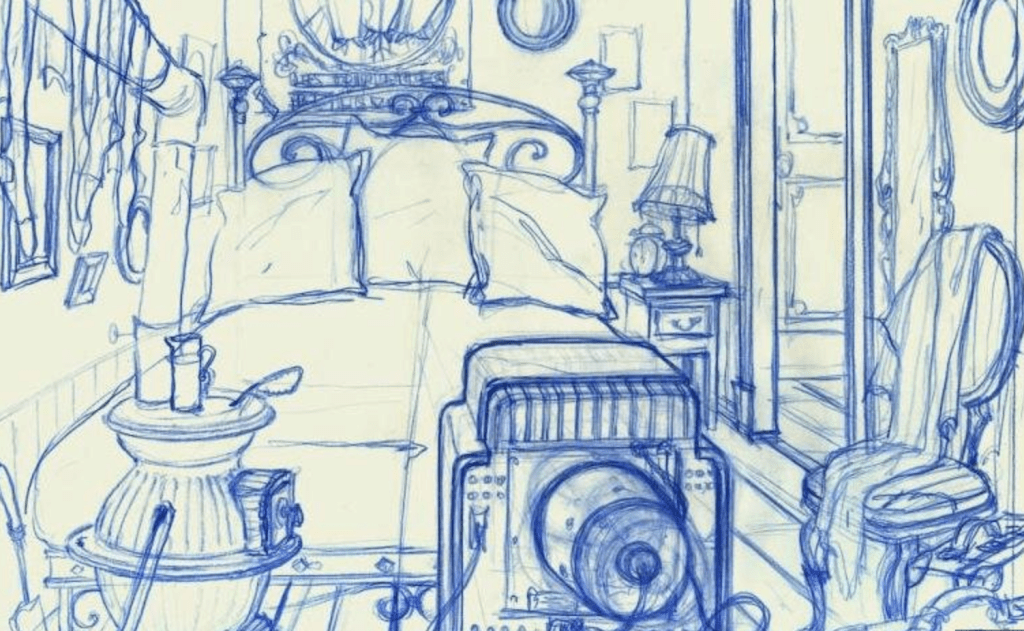
At the same time we’re having quite an accurate anatomy and a realistic feel so we have this mix between realism and then goofiness which makes the film and the feel of the characters very unique in my opinion. If we look at the linework we can see that it’s done in pencil giving it a traditional look which seems fitting for the film that seems to be set in the period of the 1920s. You can also notice how the line is kind of sketchy in the feeling of it and it gives it a sense of informality turning our attention to the design. There’s a clear line with overlap at intersections and this makes the design very readable which is often the case for cartoons in general but I think in this case here. It’s just very beautiful work on the animators’ and character designers’ sides. I think one thing I should mention about the design is that it has many quirky details such as the grandmother’s shoe, where one heel is really large because obviously a short leg and a long leg and this is what gives her a lot of character also the very thick glasses and the dimensions of the head there’s also something that’s exaggerated here also notice the very fat dog.

The director is said to have gone through something similar in his life. It is like he observes people around him and creates their caricatures and in a way his films are a version of his reality.