Using the theories of extended reality, I will break apart my own work and analyze it through the lens of Extended reality to see if it becomes more effective, what could be gained from using the medium and are there any risks.
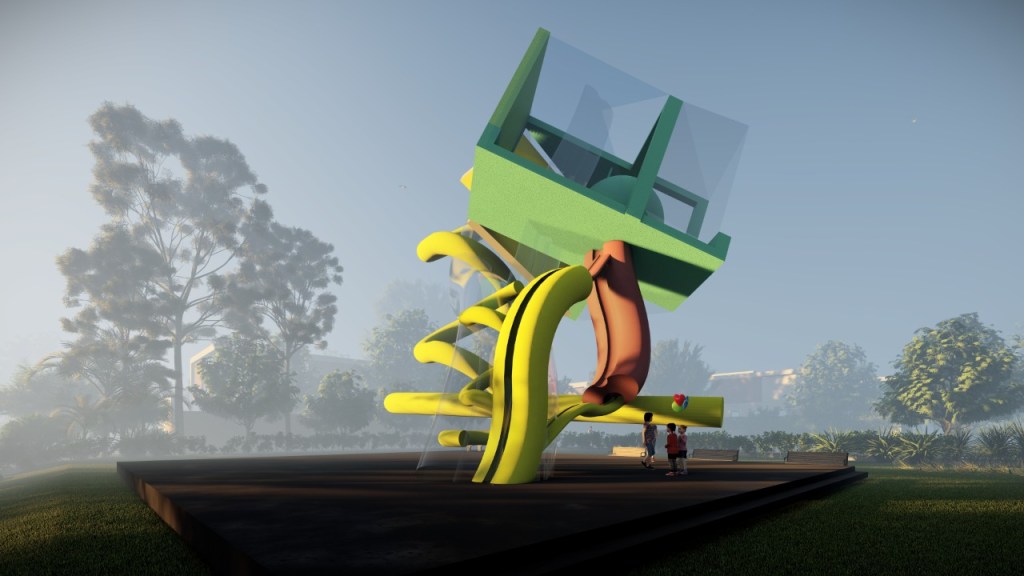
Below is a project I worked on for IAPex (architectural design conference). We were required to create a sculpture that was a combination of; Futuristic, Continuity and Boldness. After various ideation, I realised an abstract way would be much suited and it did not need to be grounded in reality.
3D RenderArchitecural Sheet of the Project – Child’s Play
A breakdown of the aspects;
Continuity
In this spiral form, I have showed continuity through different volumes at different levels to portray complexity through continuous form and ideation. I wanted it be a somewhat linear as that is what I wanted it to be associated with
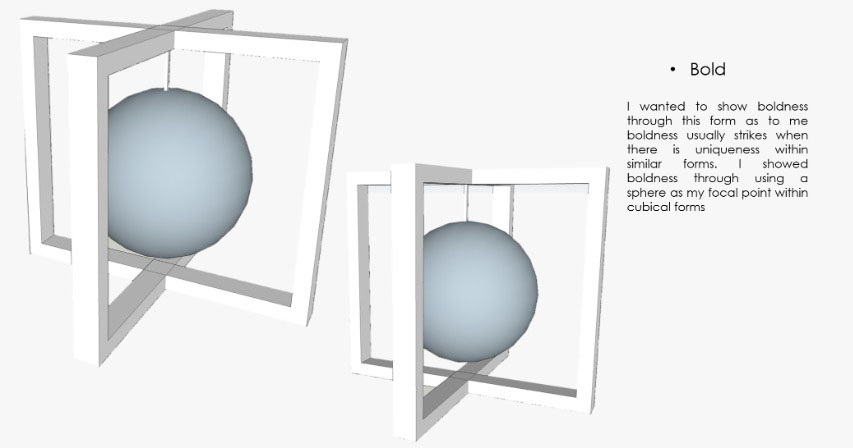
Boldness
I wanted to show boldness through this form as to me boldness usually strikes when there is a uniqueness within similar forms. I showed boldness though using a sphere as my focal point within cubical forms.
Futuristic
In this form I have showed a futuristic form through not taking its structural capability and gravity as elements affecting it.
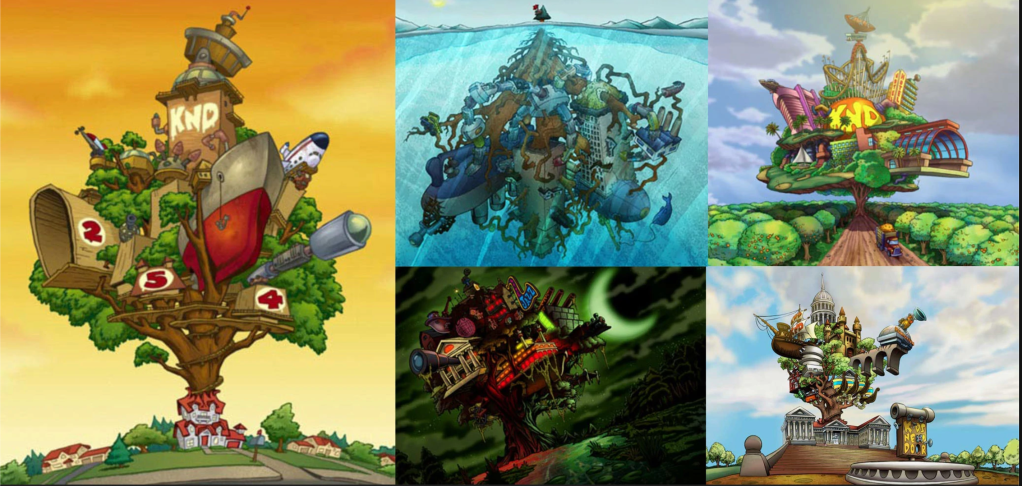
The final form looked somewhat like this. I achieved my final architectural form by combing all three of my forms and using the push and pool tool to create planes and different levels so that I could obtain apertures and play of lights and shadows. If one would observe the design is similar to a child’s play house and inspired by the animated series KIDS NEXT DOOR.
Final Form
Kids Next Door Treehouse Hideouts
How it is related to my work?
My work is mostly palyfull and ambitious. In the sense that, I try to empathise with children, their imaginations and traits.
How it could be enhanced with VR/AR/MR. What would it gain from extended reality?
When using ER, Baudrillard’s 4 phases of the image come into play and are key factors. Those being: Phase 1: Images as a reflection of reality Phase 2: Images as masking or perverting reality Phase 3: Images as masking the absence of reality Phase 4: The image “bears no relation to any reality whatever”
Architects now days are relying on Extended reality to give the clients and spectators a more feel of what they are trying to create and with a rapid advancement in technology it is only going to get better. Since my project is mostly theoretical, Extended reality would help me in pitching the idea and give the audience a much better feel of it inside and out. Not only that, if they get a sense of warmth with it, for sure the idea would be hot and people would want to invest and could the start of an artistic movement. The work could be “total work of art”.
Another thing that could be gained is when for example it goes into production, the team/labour can be trained. A production outline can be achieved. It wiuld offers a safe and realistic training environment. Where the technology costs, risks of injury, and costly damages to equipment can be eliminated. Extended Reality training provides trainees with safe experiences of scenarios.
What is the risk?
The biggest risk is that, the actual thing might not play out as similar to the simulation. The technology is not budget friendly and in its current stage it might be not that convincing.
Final Thoughts Sure ER could be used as complementary tool to just sell the idea, and to run simulations as to how the materials would work out and play off each other but nothing more.
References
Baudrillard, J. (1983) Simulations. New York: Semiotext(e).
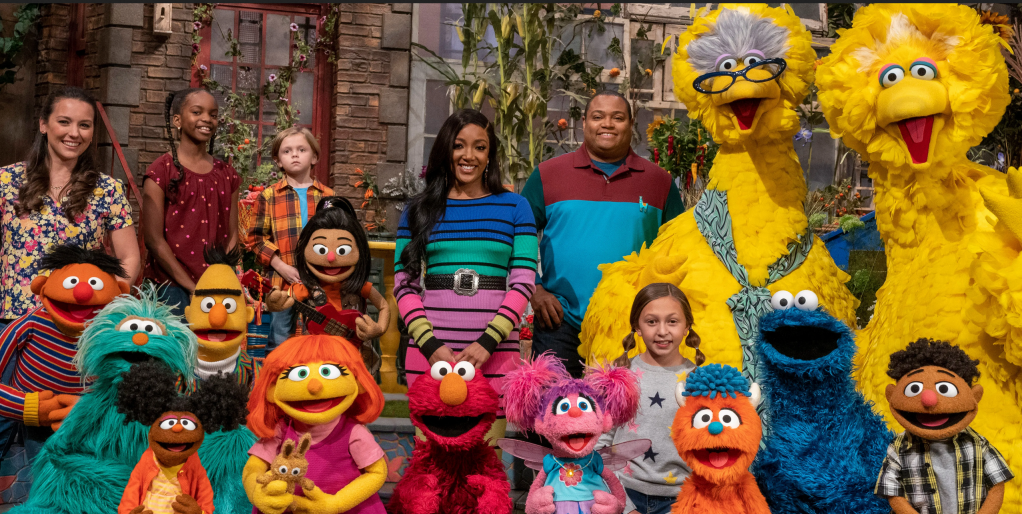
Using the theories, we learned about Affect; in this blog I will try to analyse how Sesame Street and Puppetry revolutionised children’s educational learning.
Everything began with the contentious wager that young children might truly learn from television. Episodes devoted to the letter n or the number 5 in its first seasons demonstrated the fervour of its instructional mission and its laser-like emphasis on pedagogy. Sesame Street, however, had more ambitious goals from the moment it was initially conceptualised in a 1967 report delivered by its inventor, Joan Ganz Cooney.
The world created by Sesame Street, which made its debut at the end of the 1960s, was founded on an audacious, if not utopian, vision. The show was proud to be ethnically diverse, big city urban, gritty, and unafraid of controversy. It was also occasionally psychedelic and most scary to some of its early listeners.
If you think about it although the show is targeted at 4-year-olds, and in between its charming, mainstream skits on literacy and numeracy, Sesame Street felt by turns avant-garde, iconoclastic, and revolutionary.
It speaks to a much older audience as well. For example, the primary audience are adolescents, while the secondary or tertiary audience are their parents. Imagine a child watching it with their parent, some of the jokes might be subliminal but a parent would instantly get it. If they approve, they would let their child watch it and in turn encourage other parents to watch it their kids. So, in a way it has an effect on promoting educational viewing.
watchmojo lists down the top 10 moments when sesame street got real
There is no disputing that the programme redefined the role puppets may play in your upbringing and deserves praise for addressing issues that affect kids (which are also still prevalent). Initially starting off as just a tv show largely funded by Children’s Education Theatre, has expanded into a billion-dollar franchise with multiple tv series, films, video games, musical videos and an ever-expanding merchandise to become self-funded.
Puppets are safe, entertaining, and a logical development from the instructional cartoons that kids probably see at home, puppets are ideal for attracting their (children’s) attention. Puppets encourage children’s imaginations to flourish as they mature and improve their social skills while also boosting the creative avenues that are already available to them.
For example, puppets can be of various colours, sizes and faces and these abstract features lead to characters being more empathetic. Child would instantly associate with such. For them puppets would be like another toy or plush toy. Even in therapy e.g., children how have become voluntarily mute are seen to share their feeling and thoughts only to puppets rather than a being. The best thing about puppets is that you send all kinds of messages through them to every age group and no one would mind. The visuals of the puppets create a sense of relatability and that is what has made sesame street so effective.
The impact that it had is enormous. It was not only translated into different adaptations but every country or so has its own localized version of Sesame street with some of the same principal characters.
It tackled on topics from divorce and school bullying up to sexual harassment and racism. They created emotional engagement not only through their script but characters designed are what sold it. The characters designed are mostly animals, caricatures or similar to child’s crayon drawing. No matter the audience, this revolutionary program is able to appeal to all ages and genders, as each viewer can see him or herself in at least one, if not all, of the characters and that is the beauty of it.
Using what we learned about Race and Gender Theories, I would like to analyse the Culture and Race Representation in Disney animated film Aladdin.
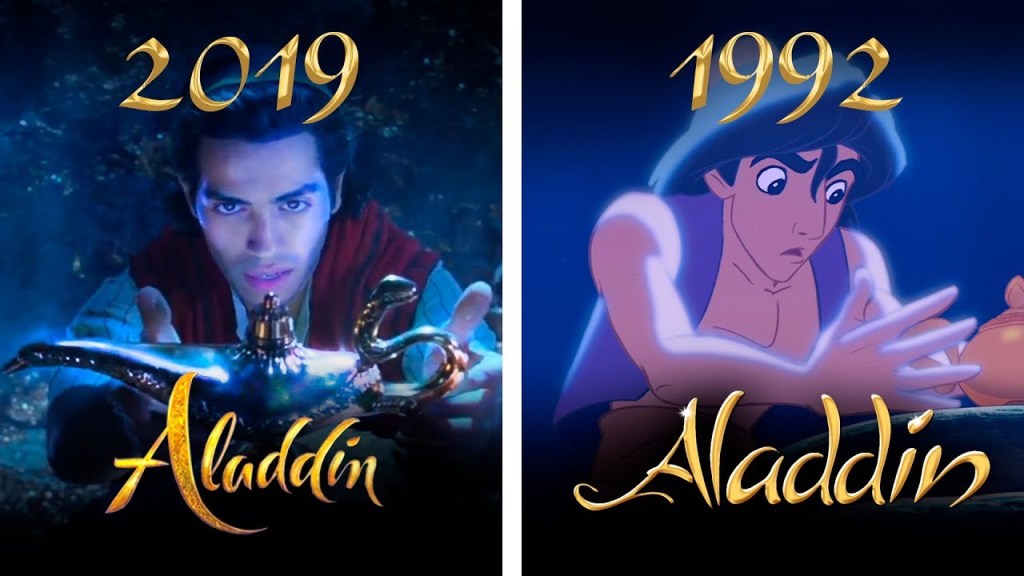
Remake vs Original Comparison
Synopsis
When Princess Jasmine, the lovely daughter of the sultan of Agrabah, meets Aladdin, a destitute but endearing street urchin, they become friends. Aladdin discovers a magic oil lamp while exploring her exotic home, and it summons a mighty, witty, larger-than-life genie. Soon after becoming friends, Aladdin and the genie must set out on a perilous journey to prevent the evil sorcerer Jafar from overthrowing young Jasmine’s kingdom.
The problem with Aladdin
The issue with fairy tales is that they offer parallel realities that clarify our own. They are sold by those who oppress us and are made to make us feel better about our privilege and ignorance. Although Aladdin is packaged as film that breaks diversity but underneath it describes how Brown people are a monolithic group of terrible people who must be subdued by Western imperialism and freed by white feminism.
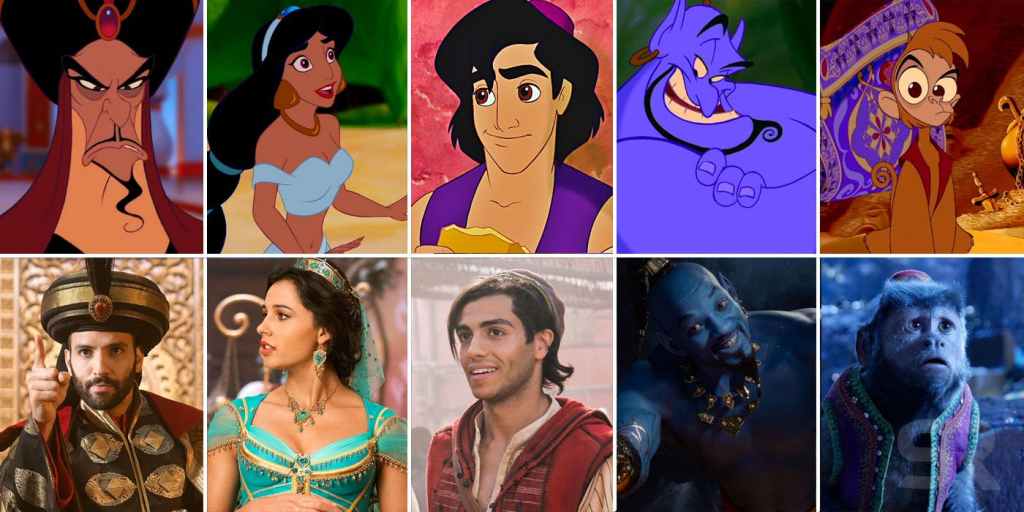
Aladdin and Jasmine, for instance, speak with a very natural American accent, whilst the villains like Jaffar embodies a British accent. While Sultan and the guards attempt to imitate an Indian or Arabic accent, the rest of the town’s residents, including the salesmen, do the same. The characters are coded to support racist and Islamophobic stereotypes, and it mispronounces Arabic phrases, including “Allah,” and portrays illegible scrawl in place of authentic Arabic lettering. Jaffar’s curly beard, traditional attire, and “queer coding” serve as additional manifestations of his wickedness, whereas Aladdin is clean-shaven, mostly shirtless, and highly heterosexual. These kinds of audio-visual clues are absolutely not accidents. What’s more mind boggling is that, Aladdin is supposed to be inspired by Tom cruise.
The plot takes place in the ridiculous “Agrabah,” a country that is “barbaric, but hey, it’s home,” according to a line from a song so offensive that the next year, Disney rewrote some of the lyrics. Agrabah is essentially “Arabland,” a made-up region that actual Americans are prepared to bomb and which is rife with popular perceptions of the Middle East as a sand desert ruled by a violent Islam. Aladdin deftly escapes getting penalised for stealing in the opening scene after introducing us to the exotic climate through a seller with a thick accent who wants to sell us his goods. Later, he prevents Jasmine from experiencing the same fate—if you steal in a hostile environment like Arabland, you lose your hand. A major misconception about middle east laws and cultures are.
Disney may be facing harsh criticism for these misconceptions, but let’s not forget that the company was once a pioneer in creating stories that were exclusively about white people. Additionally, in its “biggest ethnic marketing campaign ever,” Disney sold the movie Aladdin to Black and Hispanic children in the United States. In order for a “Brown” story to be appealing to and represent all skin tones, Disney therefore conceptualises “Brown” as a monolith that may embrace Middle Eastern, South Asian, Black, and Latinx experiences making “representation” yet another irresponsible rendition of the Other. Christian society is implied rather than mentioned in contrast to the gruesome representations of a hybrid Arab-South Asian society.
The weaponization of oriental stereotypes by the West is misrepresenting Islam. “Whenever in modern times there has been an acutely political tension felt between the Occident and its Orient (or between the West and its Islam), there has been a tendency in the West to first turn to the cool, relatively detached instruments of scientific, quasi-objective representation,” according to Edward Said in his essay “Orientalism.” Without major adjustments, this movie is tacitly supporting Islamophobia due to the source material’s anti-Muslim bias.
“In this way, Islam is made more evident, the genuine nature of its threat revealed, and an implied plan of action against it is proposed,” Said continues. Between the timing of the movie during a huge rise in anti-Muslim hate crimes and the (mostly white) people behind the camera, it’s hard to be hopeful about Disney’s motives.
How to fix it?
A problem that cannot be resolved exists deep within the blatant orientalism of Aladdin’s scenery and cannot be separated from the plot of this boys’ adventure story. Jasmine is here. We are introduced to Jasmine, who has a very non-Arabic name that is yet oriental and feminine and was named after a non-Arab actress. She is undoubtedly a girl who is being forced to get married within three days of the movie’s start “by law” and by her Santa-faced, inept father. She serves as the blank canvas for white feminism’s portrayal of itself. She plays with caged birds while yearning for love in a marriage and doesn’t wear a hijab (unless when she pretends to be a poor and so “backward” Muslim). She is the “correct kind of Muslim”—a wealthy individual with few obvious cultural traits.
Jasmine has very little control over the narrative; her part in the movie depends solely on the males in her life. Her father, for example, reveals that he is pressuring her into marriage not just because it is required by law but also because he wants a man to “take care of her;”
Jafar, who at first wants to wed her for the power but later admits it’s just passion for young flesh; Aladdin, who spends the most of the film following her, even going so far as to break into her bedroom at night and pretend to be someone else.
Furthermore, let’s not forget the sex slave scene where Jasmine is restrained and seduces Jafar in what is undoubtedly BDSM material. What is the most egregious example of Aladdin’s intersectional misogyny? The lone female character is Jasmine. That is, unless you count the “loose” women and simple people who briefly appear in songs with bare-bones lyrics. Misogyny and orientalism work together to oppress women of colour in a special way.
A couple of years ago animators and voice actors began a campaign about to culturally accurate and rich the shows should be and the characters of such ethnicity should also be voiced by a person of the region rather than hiring a mimic. A successful feat and movement in itself. The 2019 live action remake of Aladdin retains the same problem. I believe it could be toned and rewrote grounded in actually reality rather than fantasy.
What strategies could I adopt to avoid biases in my practice?
It all boils down to research (documentation, conducting interviews etc) and spending time with people of those cultures rather than word of mouth (which most people do). Not all literature is accurate, so it is best to meet people in states and try to get a sense of their traits. Get frequent feedback etc.
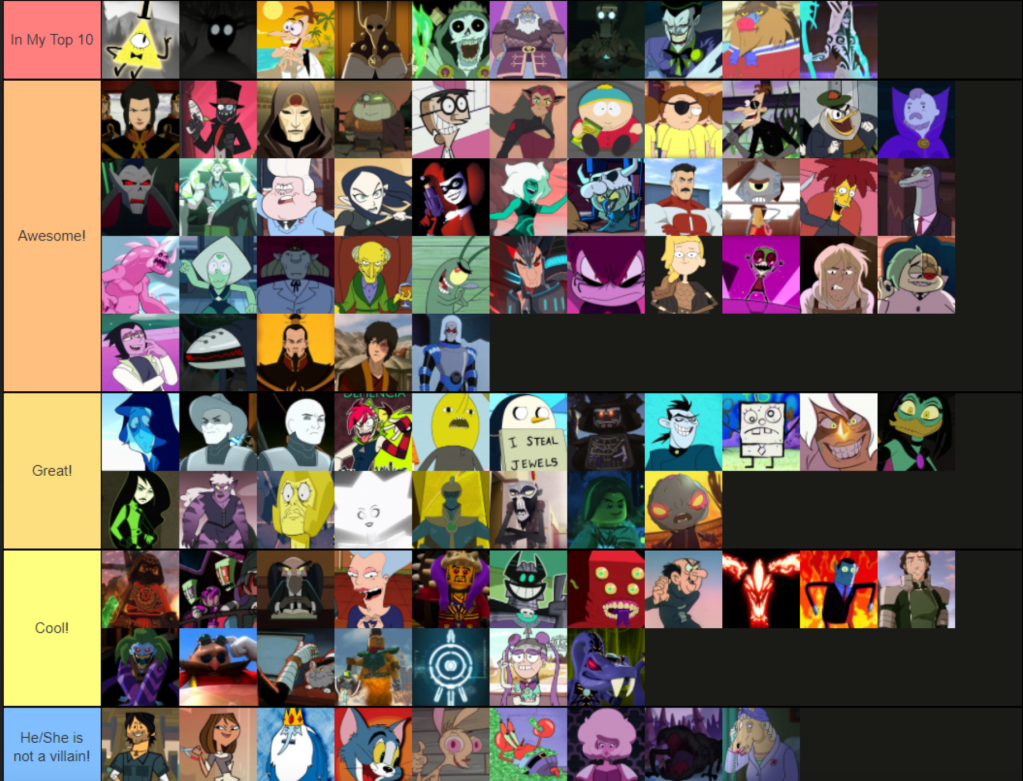
Why Cartoon Villains have a distinct design and trait? E.g., foreign accent.
Have you ever wondered why famous characters like Jaffar, Joker, Cruella and Dick Dastardly have sharp eyebrows and pointy chins? Or why they are drawn in a similar manner? There a reason behind all of this. According to a study by Warwick University, the downward pointing triangle gives a more mischievous and threatening feel in a similar manner to an angry face. Certain geometric shapes evoke negative emotions alas making them synonymous with evil.
Co-author of the study, Dr. Elisabeth Blagrove explains in a press-release:
If we look at cartoon characters, the classic baddie will often be drawn with the evil eyebrows that come to a downward point in the middle. This could go some way to explain why we associate the downward pointing triangle with negative faces. These shapes correspond with our own facial features and we are unconsciously making that link.
Have you ever noticed the accents and voices used by cartoon villains?
According to an article published by The Atlantic, Gidney (an associate professor in child study and human development at Tufts University who specializes in socio-linguistics) discovered something unexpected in the film The Lion King. According to him the characters don’t share many traits: although Scar is cynical and power-hungry, Mufasa is brave and loyal. Upon an in-depth analysis a striking difference in their accents can be noticed, with Mufasa having an American one and Scar, the lion of the dark side, having a British one.
It’s difficult to picture the final “r” in Scar’s accusation sounding quite as horrific in another tone when it floats up into a sky exploding with lightning in a pivotal sequence where Scar accuses Simba of being the “murderer!” accountable for Mufasa’s death.
Correlations between Language and Character Traits
If you pay attention, you’ll find that throughout many children’s media, the evil characters are given accents from foreign, non-U.S. native English speakers, almost as a defining characteristic. All of the “bad” characters were voiced with foreign accents and unusual dialects. It may not come as a surprise that language is used in children’s programming to distinguish between characters and indicate dramatic action.
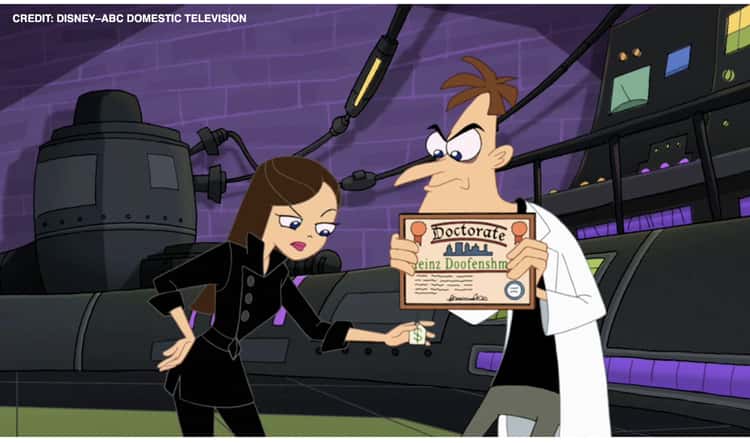
Dr. Heinz Doofenshmirtz, the villain in Phineas and Ferb, who talks with a German-like dialect and is from the fictitious European nation Drusselstein, serves as a modern day example.
This association between foreign accents and “evil” characters on television, which is a major source of cultural message for youngsters, may have unsettling ramifications for how young children are taught to appreciate diversity.
Gidney claims that it’s a frequent stereotype that the evillest foreign accent is British English. For instance, the survey discovered that British is the foreign accent most frequently utilised for villains, from Scar to Jafar in Aladdin.
For villain voices, Slavic and German accents are also typical. In addition to working-class Eastern European dialects and regional American dialects like “Italian-American gangster” (like when Claude in Captain Planet says “tuh-raining” instead of “training”), henchmen and assistants to villains frequently spoke in dialects associated with low socioeconomic status.
This week we talked about Semiotics. A very vague topic and has different schools of thought about its definition. It’s a very big concept, and there’re many strategies for semiotics, one of which is painting. Therefore, I’d like to discuss Realism through the work of an impressionist painter Edward Hopper (1882) famous for Nighthawks.
Realism, in philosophy is a perspective that grants things that are known or observed an existence or in nature that is unaffected by who is thinking about or viewing them.
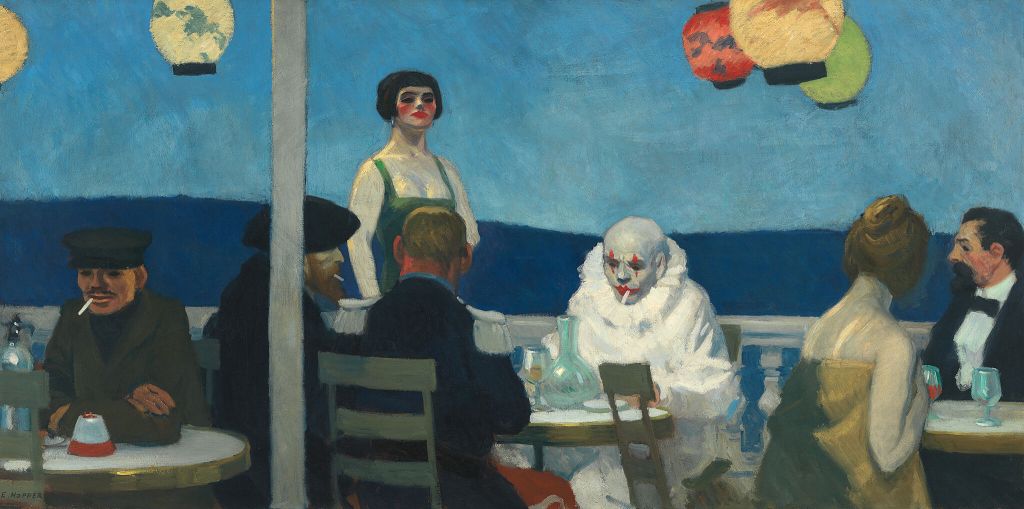
Soir Bleu (1914) Hopper, Edward
The following is the painting Soir Blue (1914) or Blue night. The painting is more grounded than it looks. The focal point is a white clown in his stereotypical white puffy clothes and is following the myth of being a depressed and smoking. This is the connotation and myth that a clown is a symbol od fepression and two faced. One face/personality that he shows the world (his happy side), the other he is in actuality (the depressed side).
The Denotion here is the way people of certain stature are supposed to dress. If you observe the people around it tells you different stories, they all emit e.g. the way the people are dressed highlights a stature in class. The couple on his right are much disturbed by his smoking and appearance or act. Across from him are two other interesting characters: judging by the patches on his shoulder one seems to be a military officer in full uniform and bearded man dressed in black is visually similar to Van Gogh.
The women behind could either be a waitress or another customer at the restaurant, has a haughty posture and looks down at the clown. The bloke on the far left of the painting sported in mud colour seems to be indifferent of the situation. It is worth noting the colour scheme of the people in it. Colour depicts character traits.
The setting itself is a vital character, to justify the story. Some might say it is a restaurant, while some a café but the Chinese lights suggest something else entirely. All in all, it can be agreed that story is about loneliness and how alienated one can feel. It also tells about how one feels the society perceives him or how one is fooling his way through life.
That’s the beauty of this piece that it can be depicted in as many ways as one wants. Regardless of these interpretations the painting tackles and everlasting concept.
The recent trend for Transmedia is to adapt movie franchises into TV series (Rings of Power, Marvel shows, The Mandalorian), or to create spin-off content in various medium.
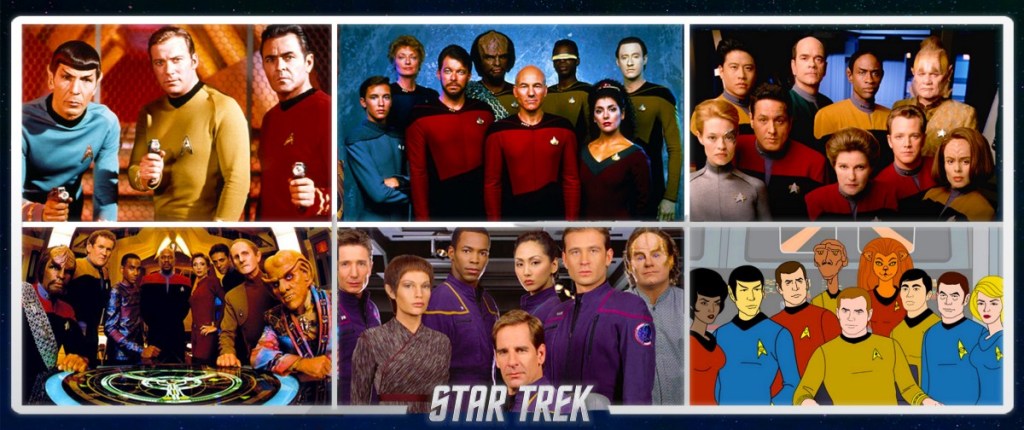
The concept of transmedia has been prevalent in the society for over a century. Initially this used to be limited to short stories and comic strips but in the developing world it has taken a more commercialised approach and has expanded to multiple mediums such as books to films, films to tv shows and their various merchandises. To video games and radio dramas just to name a few. Star Trek would be a very good example of this. After The tv series ended, the stories continued into an anthology of films, books and ever expanding tv series such as animated series and shorts. Such was the craze that people do cosplays and write their own fan fiction of the franchise. Much to this is partially due to the ever-evolving media and credit has to be given to online streaming giants such as Netflix, Amazon Prime, Paramount+ or be it Disney+. These modes of media have introduced a new generation of audience every time. Franchise such as DC, Marvel, Star Wars and doctor who are the top contenders.
Star Trek Franchise
But are these contents considered good Transmedia Storytelling?
If they did not sell, then the studios and production houses would stop making them. A very effective marketing strategy is the world building they do in these various spin offs and merchandises. Every iteration flaunts the idea that all these content interconnect and interact with each other, and they would all come together at the end. The viewer clearly buys into it. Whenever a new Star Trek media comes out, people rush so see it because they are afraid of missing out and not being able to catch up with the overall arc in the chapter.
Hence, I do not agree with this type of trans media as being good forms of storytelling. The key reason for the spin-offs being sub-par is the content has been mostly commercialized and when adapting in to different mediums it gets lost in translation. Another reason would be that they were not designed to co-exist with the source materials. Most of these contents were written after the original source has ended, and then the creators decided to add a backstory or sequel for a popular side character. They mostly serve as fan service.
Good Transmedia Storytelling should have consistent character development across the various media, and each medium should contribute to the story arc and the overall world-building.
To what extent does transmedia set limits and/or open up possibilities?
The stories mostly get lost in translation when translating to a different media, but then again, every media sets up its own limitations. One of the reasons would be is that we have transitioned into a franchise fatigue, as companies are milking the characters and stories. Most of the work have now become derivative and uninspiring. Most people would blame the budgets when transitioning into different mediums but I believe every story has a limit and after a while it starts to repeat itself. It is more or less the same story just being told in a different perspective. In an interview with Marvel Producer Nate Moore, he mentioned how Marvel never hires comic book writers or fans when adapting a film or tv show. The reason cited, is because they themselves have set the limit as opposed to hiring fairly unknown people, who get to bring their own flare to characters and stories.
There is no refuting that Transmedia as opens up limitless possibilities but have mostly become cash grabs for studios.
What would a transmedia version of your work look like?
If it was up to me, I would avoid going for a more transmedia route and would try that every story would be its own self-contained story, while the one next would honour the previous one. I think this method would keep the characters evergreen and the stories engaging.
In my opinion reality is a more subjective than objective i.e., people live in a bubble throughout their lives (whether it’s their environment or cultures) and it and perceive the world around them through this lens. For this blog post I am going I will try to compare the effectiveness of two different approaches to realism in two different films in two different media objects. One of these films is the animated short by PuffBall Studios Swipe and the other is an art film by Pakistani director Sarmad Khoosat, Zindagi Tamasha.
Both films raise a prevalent social issue about how people are forced to be oppressed by their religion and how these so-called care-takers of such religion give it a bad name. Before we begin, I wanted to introduce an Islamic concept known as Fatwa. A fatwa is basically a legal pronouncement. It is the opinion of someone called a mufti; that is an Islamic legal scholar who is capable of pronouncing his judgments, his opinions on any kind of legal issue with regard to Islam.
A summary of the two films
Swipe (animated film) – Swipe tells the story about how people have misconceptions about their own religion and have been given the tools by the so called custodiams of Islam that they have the right to pass their judgment and execute at their own will. In the film we are introduced to an app iFatwa that is an amalgamation of apps such as tinder and facebook where people can vote and decide who gets the axe. Swipe is an attempt confronting a growing crisis resulting from a culmination of the nexus of technology, extremism and fascism. At the heart of this story is a confrontation with increasingly hostile, alienating, divisive circumstances and a plea for greater empathy, before it’s too late.
Swipe – Animated short film
Zindagi tamasha – Rahat is a venerated old man who works in real estate and cares for his bedridden wife, as well as being a devout Muslim who writes, composes, and even records hymns praising the Prophet. One day, he unintentionally does a dance in front of his pals while attending the wedding of a friend’s son. His dance is captured on camera, posted to social media, and eventually aired on television. And the orderly existence he had started to become chaotic. Nobody else in the world, including his wife, is aware of Rahat’s situation. His neighbours and daughters criticise him, and his friends ignore him. A calm and thorough depiction of difficult themes in a conservative Muslim society is given in Circus of Life, which provides a calm and detailed picture of challenging issues, in a strict Muslim society and the search for the identity of an elderly man who gradually comes to realize his “minorities”.
Zindagi Tamsha – Official Trailer
Strategies for Realism in Swipe
As evident it is a combination of Animation in realism and immediacy. While watching the film you are subconsciously aware of the media but a minute in the story you are fully immersed and forget the existence of the medium i.e., the subject starts to take a toll on you and you start to empathise with the situation, because everyone has been at both the giving and receiving end at a certain point of their life. The story breaks the 4th wall and implies these same strategies through the lens of its characters. Swipe is a social commentary that how social media and technology has limited people to mindless zombies and click baits cause people to pass of their judgement quickly. The so-called custodians of Islam, “the muftis” have led people to believe that they have a right over everything i.e., can execute people at their will, impose any such laws and obligations on one another and how easy it is accusing the other as being blasphemous.The backdrop of the story is that people think they can control the earth and nature, which ends up turning it into an alienated society, and as a consequence only forces mankind to become hostile and use religion as a tool for warfare, which is a critical reflection of reality.
Strategies for Realism in Zindagi Tamasha
The film is a combination of Poetic mode and a pinch of social realism. The film is more like a character study and shows how people are forced to live their lives according to society norms and how religion has an effect on this living. Even a devotee Muslim is rendered emotionless e.g., he cannot smile, make obscene joke now and then. He has to express love and excitement in a specific way. How to dress, how to behave to name a few. The film tells a tale of woe revolves around conservatism and intolerance. It focuses on feelings and puts things into an abstract, more lyrical form. It shows how alienating things can get when you break the pattern. An example would be Soir Bleu by Impressionist painter Edward Hopper. The painting is about a sad clown in café surrounded by people of different statures. Just like this the film shows how hostile and shunning the society can get when you break its “rules”. The criticism ranges from memes on Facebook to active exclusion from events. Eventually, Rahat is reduced to a pariah in a society that once exalted him—even facing backlash from his daughter, who berates him for acting “beneath his station.” A critical state of society.
Two different forms of realist representation
Both have REPRESENTATION and this weighing expression immerses one into the story, tangibly understanding and feeling it, but the difference is that Swipe uses music and form to make you feel like you belong to the story too, enhancing the audience’s sense of belief in the world of the story, while Zindagi Tamsha makes you feel like you yourself are a listener to the older story from the perspective of a first-look interview. Realistic animation in animation can address real social issues in a unique and powerful way for the viewer, it can hit people straight in the heart with its story and use context to make the viewer reflect on real life. Biographies, on the other hand, tell the audience what happened to them through facts and statements.
To what extend is my work realism?
Whenever I approach any work, the biggest concern is, would peopl be able to empathise with it? The story that it should tell are real world stories whether they are symoblic or character driven. I do consider my work to be inspired by impressionist painters and how they did story telling. I follow the simple saying of “A picture is worth a thousand words”.
This week’s topic was about narratives and if storytelling and interactivity go hand-in-hand. Although my group discussed a show called Adventure Time, which works in an episodic format that is in line with Vladimir Propp’s 8 characters types, time to time has experimental narratives, works as a bit of all the types (graph, network and tree) and follows torodov’s narrative model where the equilibrium is upset and the characters go on a journey to fix it and set up a newer one in the process.
I wanted to tackle on a more non-traditional type of story, where all those characteristics mentioned above are seen through a different lens. For this I will be talking about the film adaptation of the novel The Little Prince.
The Official trailer of The Little Prince (2016)
The film uses the book the little prince as a plot device and instead of being a page to page adaptation it uses the book, well as a book. The story is about a minor who is put under societies pressure by her parents to get the best education, excel from prestigious institutions and leave a rich and mundane life. During her summers she encounters a raunchy neighbour known as the Aviator and grabs her attention through an illustrative book based onn his life experiences. She then starts to see the bigger picture and realises what life and living is all about.
The film is somewhere in between Aristotle’s dramatic unities, in the sense that it does not follow an arc set within 24 hours but does have a linear narrative where the traditional narrative emphasises time space and causation as well as linear cause and effect and clear endings. According to this determinant, this animation fulfils these criteria. However, unlike traditional narrative, the story unfolds in both the real world and the mental world, so a double narrative is present throughout, sometimes even up to three parallel narratives. And these three threads are always interacting with each other at all times. These are all features that are different from traditional narratives.
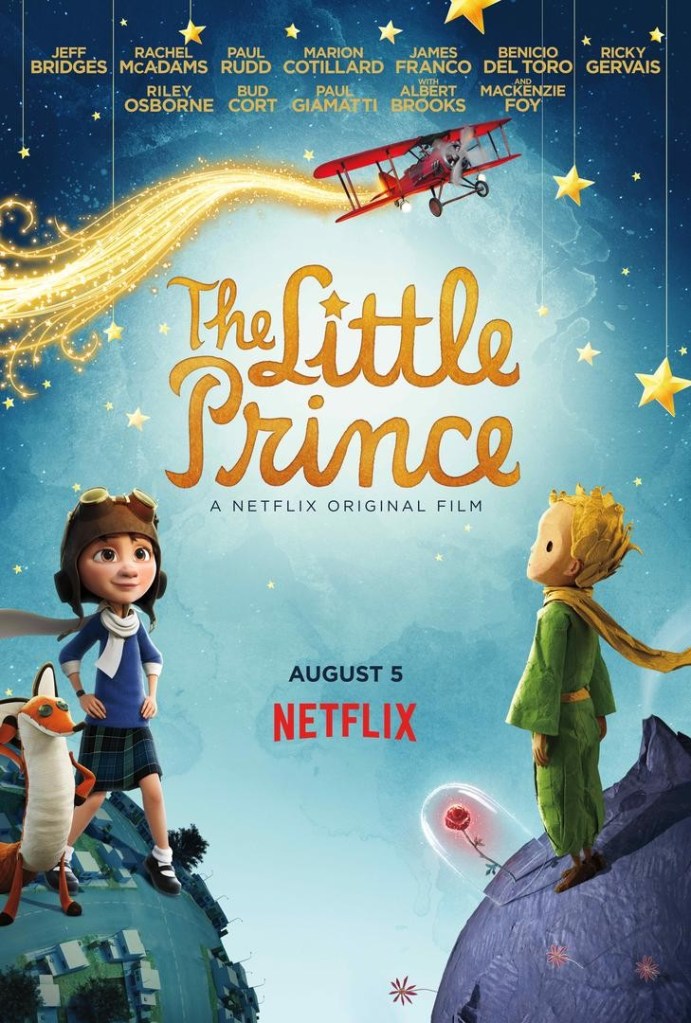
Film Poster
Speaking of Vladimir Propp’s 8-character types, some characters act as more than one while some are symbolic characters.
The Hero – Little Girl, a smart, feisty and precocious girl with a kind heart. She has a very inquisitive mind and struggles to balance growing up and basking in her childhood.
The Aviator as various characters e.g. the Father and the donor. The Aviator, an eccentric and retired aviator who befriended the Little Prince in the Sahara Desert and acts as a mentor to the Little Girl.
The False Villain – The little girl’s mother, who organises her entire life according to her will and is an absentee parent.
The Villain – though there are not any such villains in the story but I regard as time itself being one. One of the messages given in the film is ‘Growing up is not a problem, but forgetting your childhood is’.
The False Hero – The little prince an eternally young boy and resident of “Asteroid B612”, a small asteroid roughly the same size as him. The adult version of Little Prince who has forgotten his own childhood and becomes an anxious, incompetent janitor for the Businessman.
Levi Strauss’ Binary Oppositions
The film clearly makes it about ChildhoodVS Growing Up, or more precisely Little Girl VS society that dictates her life. The film is resolved as Little girl realises what it means to be a kid and enjoy the moments of life.
Todorov’s narrative model
The film follows a linear narrative. Has an equilibrium that is upset when the girl starts to feel that everyone is alone a one point or another. She embarks on a journey to find the Little Prince and set what is meant to be. She realises the purpose of life and this creates and new equilibrium in turn.
For the second blog post I wanted to answer the second question in which we were to select a media object and analyse it through the lenses of medium specificity and gesamtkunstwerk. Can it be considered a total work of art? Does it share any features with gesamtkunstwerk? Is this a positive or a negative thing? Why? Do you think that its specific medium has affected creative choices? Would it look different if it was created with different tools? How so? And what would be the implications of such changes?
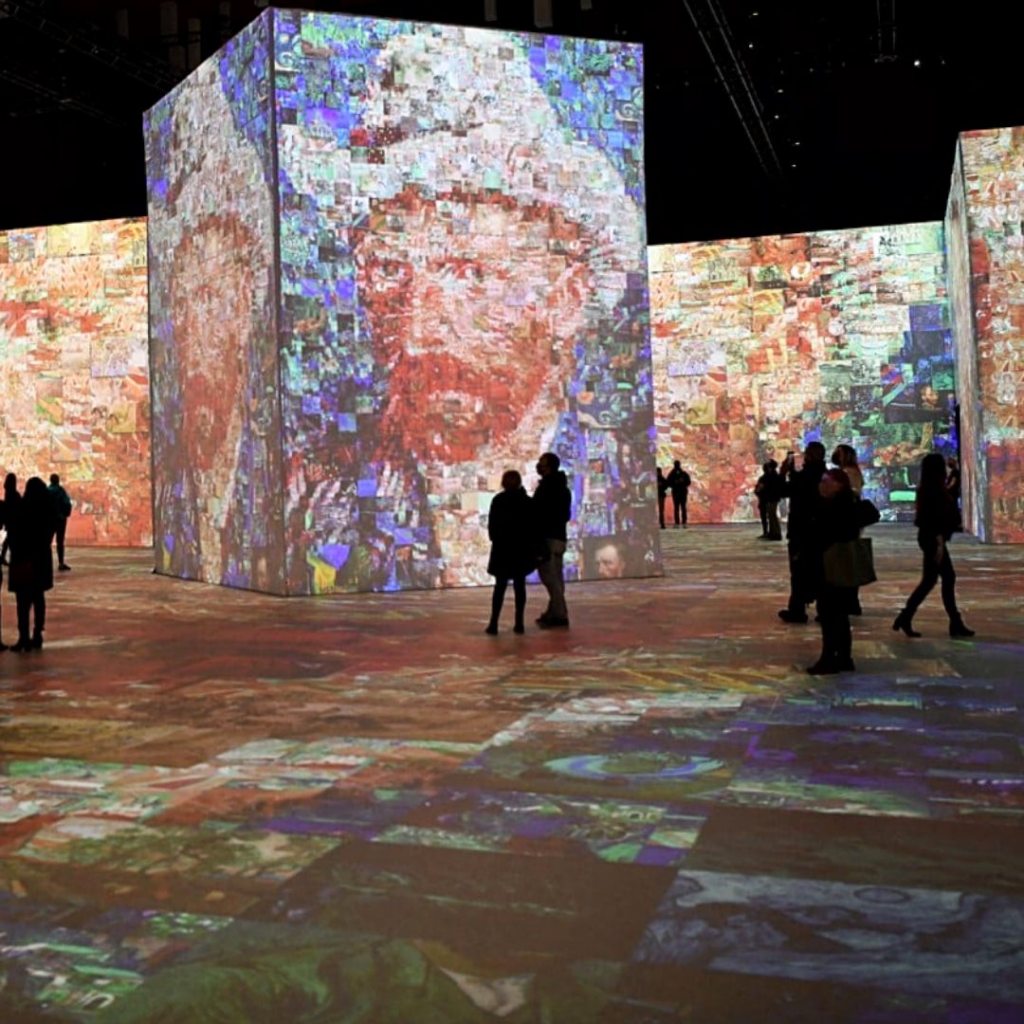
Projection mapping is something that has revolutionized installation art. The technology itself is being in films. The Mandalorian was the first to use this and The Batman improved on this. The way it works is, an environment is created through projectors, which gives an illusion of you being actually in the situation.
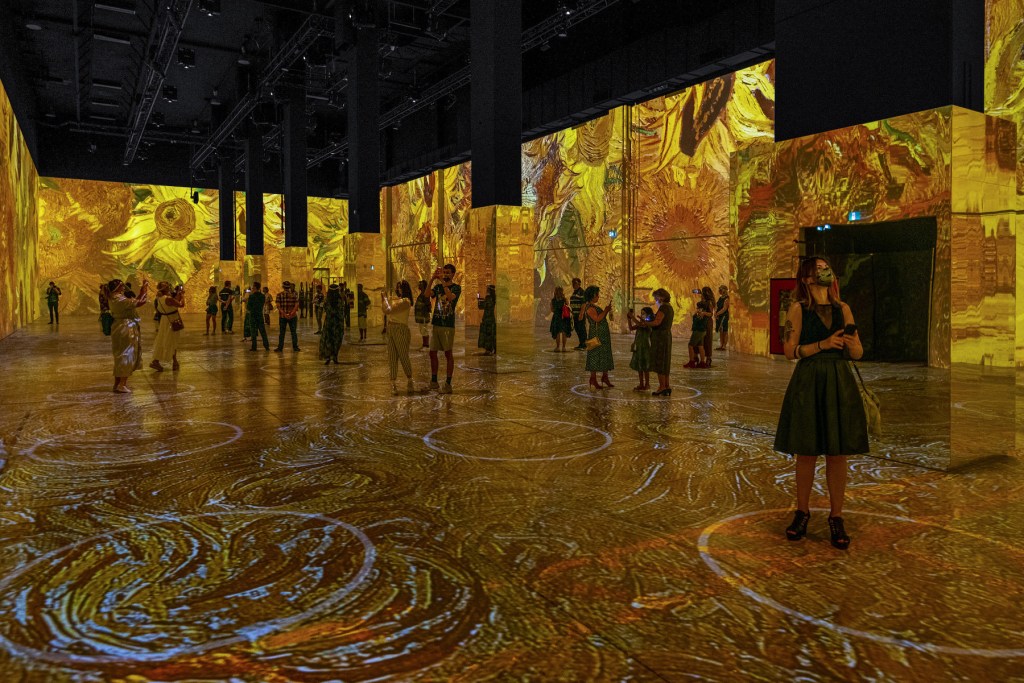
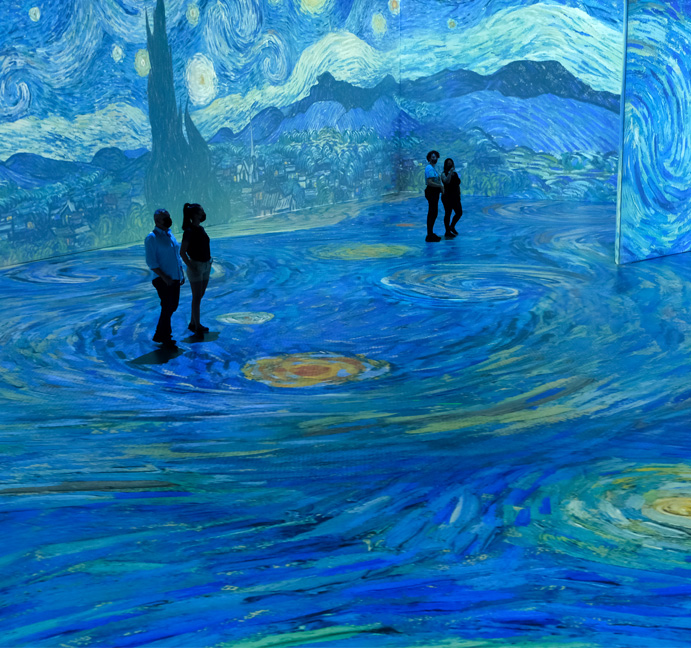
A notable example would be the Van Gogh Immersive Experiences in London and US. They are operated by various companies and have converted over 100 of his paintings into a digital projection. The projection is not just a still image but is an animated collage and with immersive music, it feels as if you have stepped inside his paintings.
From the Starry night to wheatfield with crows all are there to experience. I think this a better way to expand the reach of an artist’s work to a whole different group. Though I would recommend going to the museum and seeing the actual one physically but with technology like this you could really feel the colours and compositions come to life and could spend hours gawking at the artwork. This would save time, away from rushes in museums plus a place to spend the day with friends and family.
Installation view of Immersive Van Gogh. Image courtesy Immersive Van Gogh.Immersive Van Gogh Exhibit
Yes, I do consider this medium to be a total work of art as it is an amalgamation of different forms of art. That being it is a collaboration between different artists e.g. illustrators, graphic designers, programmers, curators and musicians.
Installation view of Beyond Van Gogh Image courtesy Beyond Van Gogh.
The other way to do it would be to use LED screens (which would be costly venture) known as Virtual Production. Although it would also require a collaboration form people of vastly different field e.g. designers, concept artists, 3D illustrator, colouring artist, VR, technicians etc.
We all know about mixed media artworks and now it has a name; “Gesamtkunstwerk” or total work of art. Before we begin, let’s take a crash course into what the terms actually is. A Gesamtkunstwerk is a work of art that makes use of all or many art forms or strives to do so. The term is a German word which has come to be accepted in English as a term in aesthetics.
The term was first used by the German writer and philosopher K. F. E. Trahndorff in an essay in 1827. The German opera composer Richard Wagner used the term in two 1849 essays. It is unclear whether Wagner knew of Trahndorff’s essay. The word has become particularly associated
with Wagner’s aesthetic ideals. In the twentieth century, some writers applied
the term to some forms of architecture.
Before Wagner, some elements of opera reform, seeking a more “classical” formula, had begun at the end of the 18th century. After the lengthy domination of opera seria, and the da capo aria, a movement began to advance the librettist and the composer in relation to the singers, and to return the drama to a more intense and less moralistic focus. In lay man terms Gesamtkunstwerk, (which roughly translates as a “total work of art”) describes an artwork, design, or creative process where different art forms are combined to create a single cohesive whole.
There are going to be two blog posts on this topic and each will tackle a different aspect/media object in relation to the topic.
For the first part we were asked to select an example of your own work and analyse it through the lenses of medium specificity and gesamtkunstwerk?What is special about your medium, how is it connected to other media? How would your work change if you used different tools? Is your work a gesamtkunstwerk? Would you consider turning it into one? What would change?
Just like Wagner, I consider theatre to fall under the category of gesamtkunstwerk. Being a theatre actor and director, I directed and wrote a play on the ongoing Kashmir issue. Instead of picking sides or giving a biased review I went for an unexpected approach. Being an admirer of radio dramas, I encompassed that into the story itself.
Here is a like to the play;
The story plays our like a radio drama and the I wanted to make a statement on media as to how to depict such events. For example, the ongoing Kashmir issues plays out differently for everyone. The Indian media depicts it differently, the Pakistan does something to evoke their people and while those living there, they experience something entirely different. Being a puppeteer, the medium I opted was a shadow theatre performance.
The play mostly relied on sound effects and music and was devoid of any such dialogues (the only ones were archive news bulletins). My goals was for the whole play to work like a radio drama, where the visuals and optical sound would submerge the audience into a fantasy of their own and image their own scenes according to the sound and hence create a more immersive experience. All of them organically bolstered the experience of the other medium and that is the beauty of it.
My ideals/work do align with being a Gesamtkunstwerk, for example the play combined different mediums i.e. lights, paper, music, foleys, puppetry etc. I can agree to an extent by what Armheim said;
“Not only does speech limit the motion picture to an art of dramatic portraiture, it also interferes with the expression of the image”.
If I were to attempt a similar story, I would opt for an installation art as a medium instead and would have used newspapers and lights for shadows to create it. Then again it might have had not been much more effective.



 Arsalan Awais