Blog Post 3 | (Narrative thoery & interactive narratives).

This week’s topic was about narratives and if storytelling and interactivity go hand-in-hand. Although my group discussed a show called Adventure Time, which works in an episodic format that is in line with Vladimir Propp’s 8 characters types, time to time has experimental narratives, works as a bit of all the types (graph, network and tree) and follows torodov’s narrative model where the equilibrium is upset and the characters go on a journey to fix it and set up a newer one in the process.

I wanted to tackle on a more non-traditional type of story, where all those characteristics mentioned above are seen through a different lens. For this I will be talking about the film adaptation of the novel The Little Prince.

The Official trailer of The Little Prince (2016)

The film uses the book the little prince as a plot device and instead of being a page to page adaptation it uses the book, well as a book. The story is about a minor who is put under societies pressure by her parents to get the best education, excel from prestigious institutions and leave a rich and mundane life. During her summers she encounters a raunchy neighbour known as the Aviator and grabs her attention through an illustrative book based onn his life experiences. She then starts to see the bigger picture and realises what life and living is all about.  

The film is somewhere in between Aristotle’s dramatic unities, in the sense that it does not follow an arc set within 24 hours but does have a linear narrative where the traditional narrative emphasises time space and causation as well as linear cause and effect and clear endings. According to this determinant, this animation fulfils these criteria. However, unlike traditional narrative, the story unfolds in both the real world and the mental world, so a double narrative is present throughout, sometimes even up to three parallel narratives. And these three threads are always interacting with each other at all times. These are all features that are different from traditional narratives.
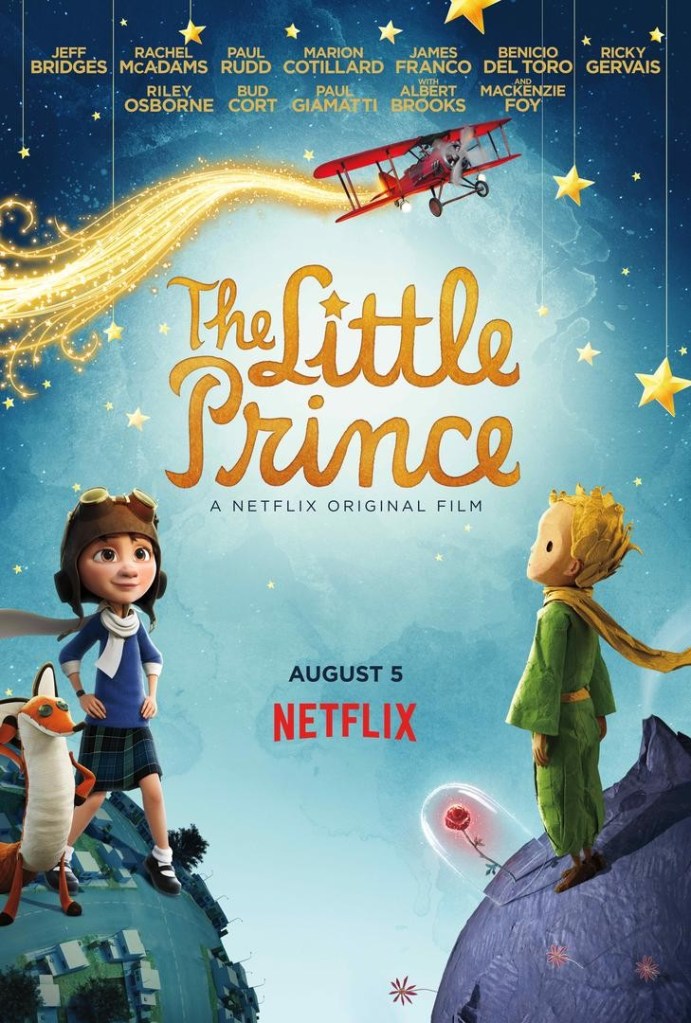
Film Poster

Speaking of Vladimir Propp’s 8-character types, some characters act as more than one while some are symbolic characters.

The Hero – Little Girl, a smart, feisty and precocious girl with a kind heart. She has a very inquisitive mind and struggles to balance growing up and basking in her childhood.

The Aviator as various characters e.g. the Father and the donor. The Aviator, an eccentric and retired aviator who befriended the Little Prince in the Sahara Desert and acts as a mentor to the Little Girl.

The False Villain – The little girl’s mother, who organises her entire life according to her will and is an absentee parent.

The Villain – though there are not any such villains in the story but I regard as time itself being one. One of the messages given in the film is ‘Growing up is not a problem, but forgetting your childhood is’.

The False Hero – The little prince an eternally young boy and resident of “Asteroid B612”, a small asteroid roughly the same size as him. The adult version of Little Prince who has forgotten his own childhood and becomes an anxious, incompetent janitor for the Businessman.

Levi Strauss’ Binary Oppositions 

The film clearly makes it about Childhood VS Growing Up, or more precisely Little Girl VS society that dictates her life. The film is resolved as Little girl realises what it means to be a kid and enjoy the moments of life.

Todorov’s narrative model

The film follows a linear narrative. Has an equilibrium that is upset when the girl starts to feel that everyone is alone a one point or another. She embarks on a journey to find the Little Prince and set what is meant to be. She realises the purpose of life and this creates and new equilibrium in turn.

References

Media, A. C. o. C. a. t., 2016. Raising Children. [Online]
Available at: https://raisingchildren.net.au/guides/movie-reviews/the-little-prince
Reflective Blog #2 | Places of the Mind

Through my animation, I wanted to show how creative and imaginative children are. Their creativity integrated with how naïve they are, portraying only children’s innocence; as we grow older and get more involved in worldly matters and lose that innocence. I was quite satisfied with how my ideas and concepts were shaping out. It portrayed and delivered the message that I wanted to convey. However, I faced some issues with time management. I spent more time thinking about my concept which left less time for working on the visuals. Everyone seemed to like the idea and the story and suggested that I should choose places of the mind and develop it to its full potential. After the feedback, I realised that I need to further develop the visuals such as the scenes showing the astronaut in space exploring the galaxy and adding a climax to show why the aircraft falls which will do justice to the concept.

Creative Development | Concept

The Story

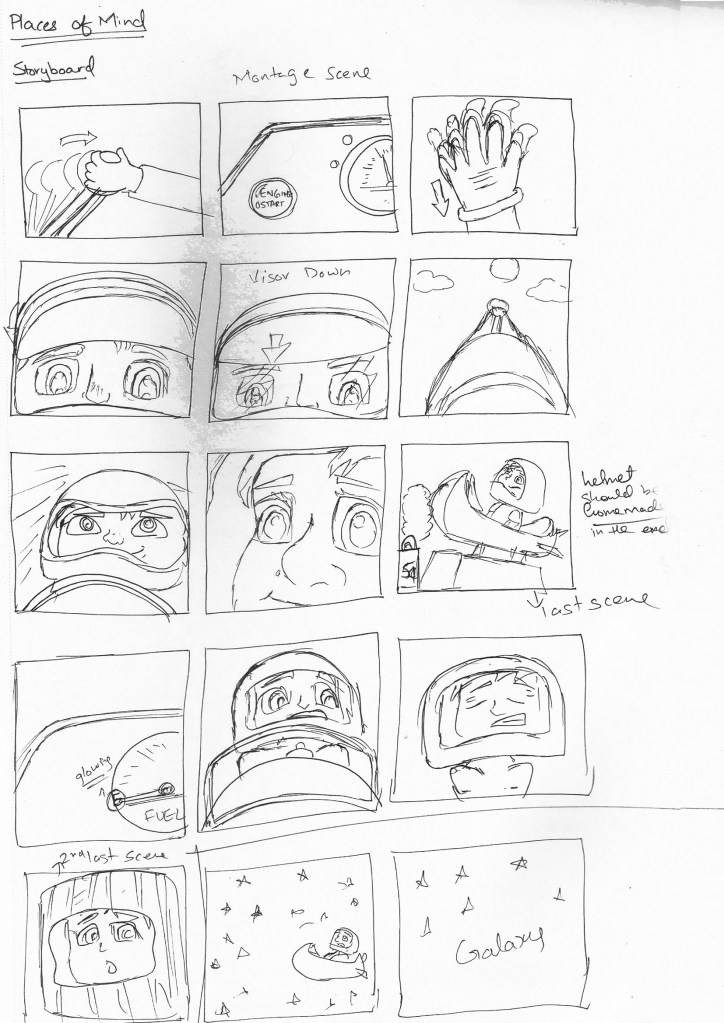
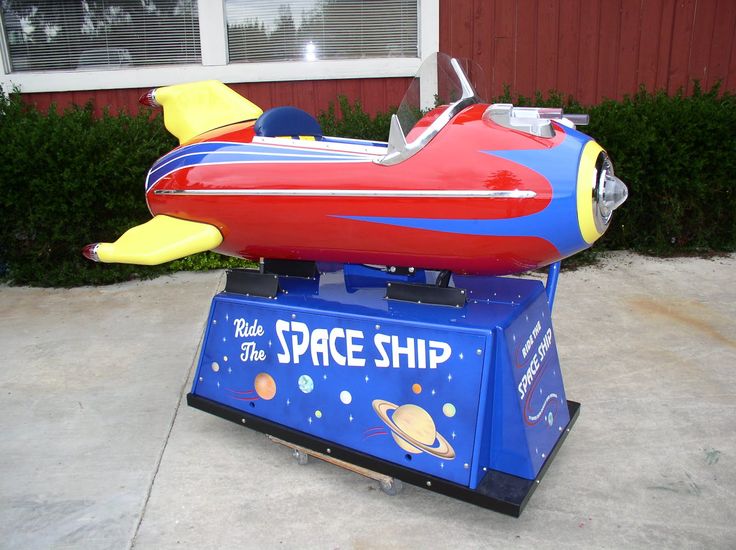
The story starts of with an upbeat montage, which included a small hand wearing gloves, pulling a lever, pushing the ‘engine start’ button, closing down the helmet visor. A rocket gets into position and blasts off. We see a kid in a spacesuit, exploring the galaxy. He gets a message from the command central that his rocket is ready to test hyperspeed. He straps in and blasts off. A montage of him passing by the planets in warp speed. As he picks up for more speed, his rocket goes haywire and suddenly he starts to run out of fuel and is about to crash. The automated driver shouts warning! warninng! . A POV shot of him flying towards the screen and we cut to him and reveal that it was a childrens joy ride and had run out of coin.

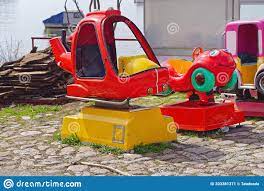
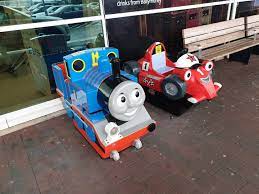
Rocket joy ride

All of sudden you get this sense that it will start to take off.

Blog Post 2 | (Medium specificity in the digital age Q2).

For the second blog post I wanted to answer the second question in which we were to select a media object and analyse it through the lenses of medium specificity and gesamtkunstwerk. Can it be considered a total work of art? Does it share any features with gesamtkunstwerk? Is this a positive or a negative thing? Why? Do you think that its specific medium has affected creative choices? Would it look different if it was created with different tools? How so? And what would be the implications of such changes?

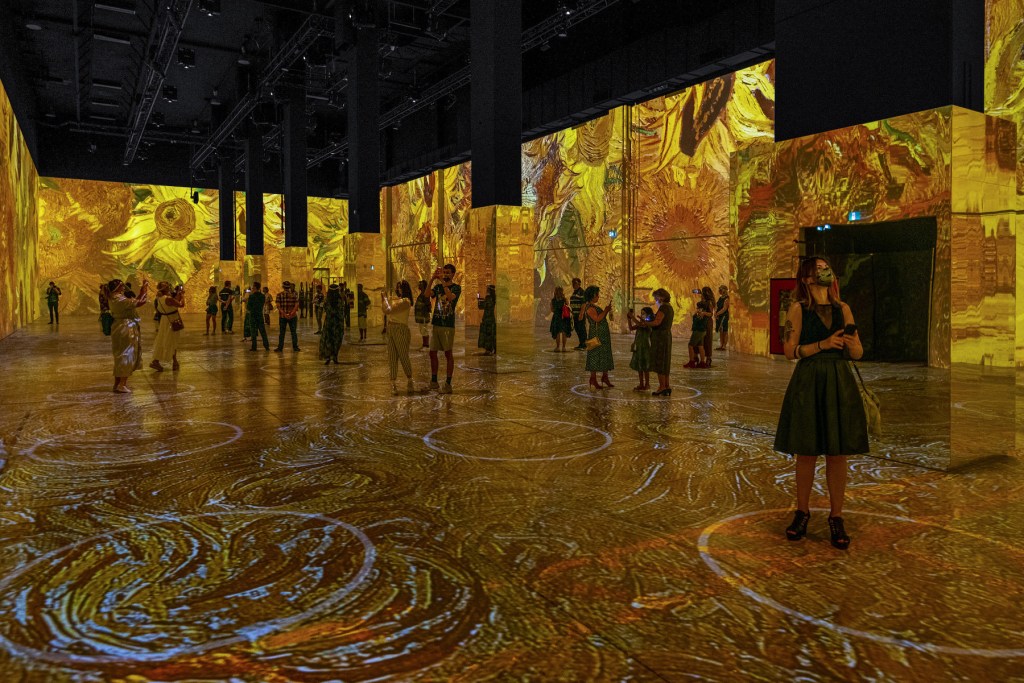
Projection mapping is something that has revolutionized installation art. The technology itself is being in films. The Mandalorian was the first to use this and The Batman improved on this. The way it works is, an environment is created through projectors, which gives an illusion of you being actually in the situation.

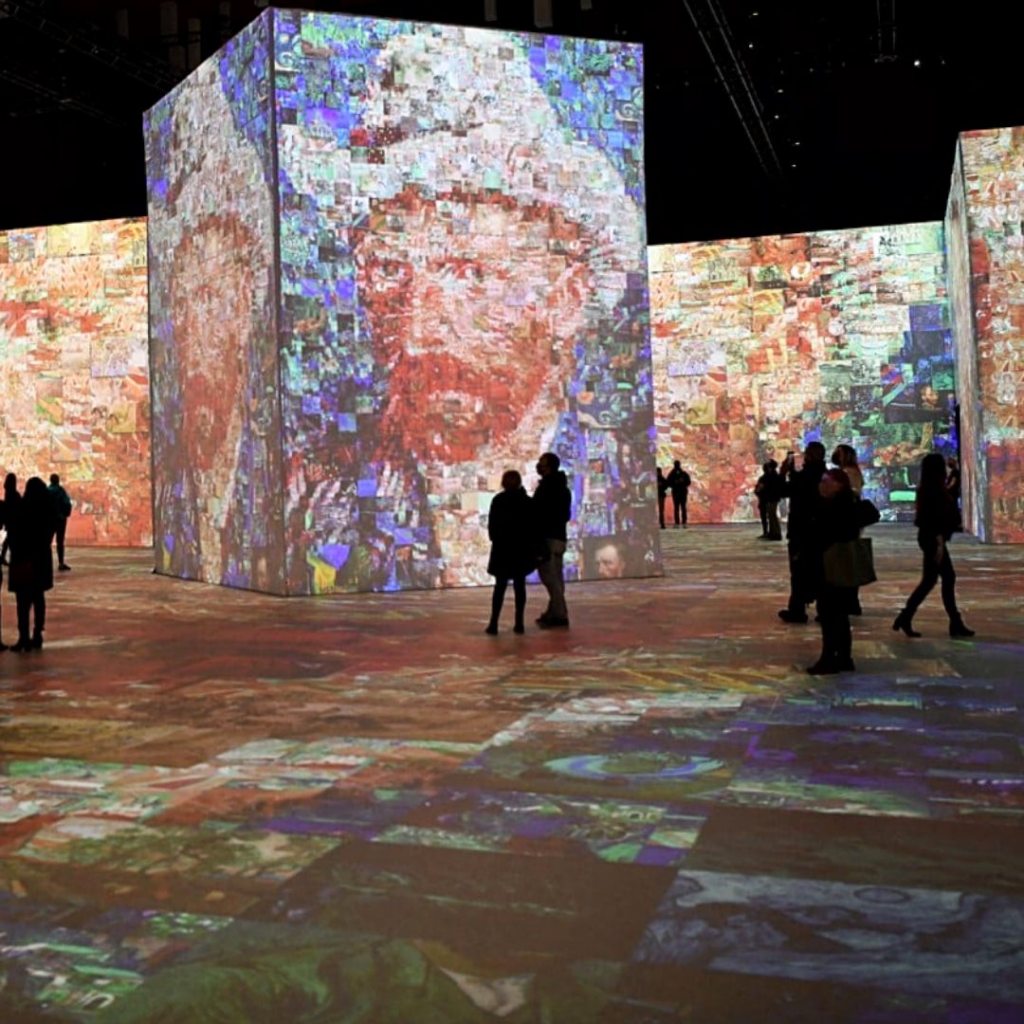
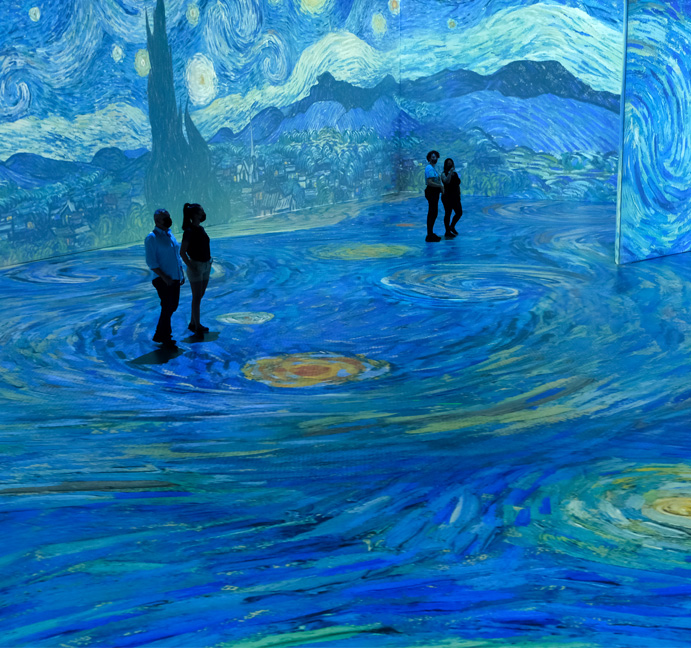
A notable example would be the Van Gogh Immersive Experiences in London and US. They are operated by various companies and have converted over 100 of his paintings into a digital projection. The projection is not just a still image but is an animated collage and with immersive music, it feels as if you have stepped inside his paintings.

From the Starry night to wheatfield with crows all are there to experience. I think this a better way to expand the reach of an artist’s work to a whole different group. Though I would recommend going to the museum and seeing the actual one physically but with technology like this you could really feel the colours and compositions come to life and could spend hours gawking at the artwork. This would save time, away from rushes in museums plus a place to spend the day with friends and family.

Yes, I do consider this medium to be a total work of art as it is an amalgamation of different forms of art. That being it is a collaboration between different artists e.g. illustrators, graphic designers, programmers, curators and musicians.

Installation view of Beyond Van Gogh Image courtesy Beyond Van Gogh.

The other way to do it would be to use LED screens (which would be costly venture) known as Virtual Production. Although it would also require a collaboration form people of vastly different field e.g. designers, concept artists, 3D illustrator, colouring artist, VR, technicians etc.

References

Anon., 2021. Artnet News. [Online]
Available at: https://news.artnet.com/art-world/immersive-van-gogh-guide-1974038

Jones, J., 2020. The Guardian. [Online]
Available at: https://www.theguardian.com/artanddesign/2020/feb/12/meet-vincent-van-gogh-experience-review-south-bank-london

Review of Projects with similar concepts

Lets get the cat out of the bag first. There is no secret that whenever we hear the word ‘Places of Mind’ we instantly think about the mind place that Sherlock introduced to the modern age. He has this whole mental palace where he stores his trail of thoughts, memories and calculates every move.

One small step – short

Instead of appropriating this thing, I believe are more old school and personal approach would be the way. You know how you are a kid and start to fantasize vivid imagery by just looking at an object. For example say you are sitting in one of rides where you put in a coin and the ride (be it a car, train or a rock) moves back and forth.

The Secret Life of Walter Mitty – Short Story

People who are daydreaming and not paying attention to the outside world are referred to as Walter Mittys.
Walter Mitty rose to prominence as a symbol of America.

This short tale seems to fit the description of a garden path story because it is written in “Thurber’s own narrative style – economical, mildly sardonic, and brilliantly evocative” (Holmes 218).
To intentionally deceive someone is meant by the idiom “to lead someone along the garden path.”

The narrative begins in the middle of one of Mitty’s delusions, in which he is a naval commander in charge of a hydroplane during a violent storm.
Mitty is the ideal officer, revered by his team for his valour and skill.
The reader and Walter Mitty both recognise that the situation is entirely in Mitty’s head: He is truly behind the wheel of an automobile, and his wife is yelling at him to slow down.
Similar real-world incidents serve as the catalyst for the other delusions in the narrative.
Mitty imagines donning medical gloves as, in the character of an internationally renowned surgeon, he prepares to operate on a billionaire banker after Mrs. Mitty tells him to wear his gloves.

Thurber skillfully contrasts Mitty’s everyday life—he is running errands for Mrs. Mitty while she attends her hair appointment—with more serious problems of life and death.
Mitty starts to see himself in court as the ideal defendant as a newsboy shouts out the headlines of a murder trial, but then he connects the word “cur” with the puppy cookie his wife has asked him to buy.
Then, in one of the story’s funniest passages, Mitty imagines himself as a gallant World War II pilot attacking a German ammunitions plant while reading a copy of Liberty magazine.
Mrs. Mitty interrupts him for the last time because he has forgotten the dog biscuit. Mitty then visualises a firing squad and resolutely rejects the blindfold.

References

One Small Step. 2018. [Film] Directed by Bobby Pontillas Andrew Chesworth. s.l.: s.n.

Thurber, J., 1939. The Secret Life of Walter Mitty. s.l.:The New Yorker.

Project #2 | Places of Mind

This week we were given the topic called Places of the Mind. This is an abstract theme and to me it covers a wide range of possibilities and imaginations. Our mind is a complex mechanism that stores all kinds of emotions, thoughts, and feelings. It is a more self reflective topic if you think about it. I started having a wide array of concepts from the get go and some were hard to filter out as I had to restrict myself to the duration of the project and the video itself. As generic it may seem, I choose to focus on the thoughts in minds. People usually get a lot of ideas which are no systematic logy there regarding concentrating on specific issue in their mind at the same time. The major statement would devours other ideas to play the dominate role in minds. Lines mess around and the explosion indicates the process how thoughts change and how a new idea is born.

In the next few blocks I will cover the different concepts that I have and will pursue one of them with a breakdown of the concept, storyboard, moodboard and rough animatic.

Blog Post 1 | (Medium specificity in the digital age Q1).

We all know about mixed media artworks and now it has a name; “Gesamtkunstwerk” or total work of art. Before we begin, let’s take a crash course into what the terms actually is. A Gesamtkunstwerk is a work of art that makes use of all or many art forms or strives to do so. The term is a German word which has come to be accepted in English as a term in aesthetics.

The term was first used by the German writer and philosopher K. F. E. Trahndorff in an essay in 1827. The German opera composer Richard Wagner used the term in two 1849 essays. It is unclear whether Wagner knew of Trahndorff’s essay. The word has become particularly associated

with Wagner’s aesthetic ideals. In the twentieth century, some writers applied

the term to some forms of architecture.

Before Wagner, some elements of opera reform, seeking a more “classical” formula, had begun at the end of the 18th century. After the lengthy domination of opera seria, and the da capo aria, a movement began to advance the librettist and the composer in relation to the singers, and to return the drama to a more intense and less moralistic focus. In lay man terms Gesamtkunstwerk, (which roughly translates as a “total work of art”) describes an artwork, design, or creative process where different art forms are combined to create a single cohesive whole.

There are going to be two blog posts on this topic and each will tackle a different aspect/media object in relation to the topic.

For the first part we were asked to select an example of your own work and analyse it through the lenses of medium specificity and gesamtkunstwerk? What is special about your medium, how is it connected to other media? How would your work change if you used different tools? Is your work a gesamtkunstwerk? Would you consider turning it into one? What would change?

Just like Wagner, I consider theatre to fall under the category of gesamtkunstwerk. Being a theatre actor and director, I directed and wrote a play on the ongoing Kashmir issue. Instead of picking sides or giving a biased review I went for an unexpected approach. Being an admirer of radio dramas, I encompassed that into the story itself.

Here is a like to the play;

The story plays our like a radio drama and the I wanted to make a statement on media as to how to depict such events. For example, the ongoing Kashmir issues plays out differently for everyone. The Indian media depicts it differently, the Pakistan does something to evoke their people and while those living there, they experience something entirely different. Being a puppeteer, the medium I opted was a shadow theatre performance.

The play mostly relied on sound effects and music and was devoid of any such dialogues (the only ones were archive news bulletins). My goals was for the whole play to work like a radio drama, where the visuals and optical sound would submerge the audience into a fantasy of their own and image their own scenes according to the sound and hence create a more immersive experience. All of them organically bolstered the experience of the other medium and that is the beauty of it.

My ideals/work do align with being a Gesamtkunstwerk, for example the play combined different mediums i.e. lights, paper, music, foleys, puppetry etc. I can agree to an extent by what Armheim said;

“Not only does speech limit the motion picture to an art of dramatic portraiture, it also interferes with the expression of the image”.

If I were to attempt a similar story, I would opt for an installation art as a medium instead and would have used newspapers and lights for shadows to create it. Then again it might have had not been much more effective.

References

Anon., 2022. Britanica. [Online]
Available at: https://www.britannica.com/art/theater-building/German-Romanticism-and-Naturalism#ref464013

Lockspieser, E., 2022. Britancia. [Online]
Available at: https://www.britannica.com/biography/Claude-Debussy

Reflective Post 1 | Red vs Blue

While I was short on time and the concept and animatic were created at the last moment, I am quite happy that it paid off a bit. The negative feedback was regarding the pacing, as it felt rushed and a bit over the place. The reviews for the visuals were quite mixed, although the colour pallete was appreciated as well as the abstract feel but everyone felt that the story was something unique but the animatic did not do justice to it. However, after discussions with Alex he and I both felt that if I opted for a motion design field rather than frame by frame animation then I could pick it up for further development. So the agenda would be to opt for a lest abstract story and work out on how pacing is done better. Regardless I think this was an effective one as I was able to approach a story symboliicaly and dive into a suffism concept. This assignemnt was effective in gettinng things started.